
For small upgrades like new flooring or a bathroom refresh, savings or a personal loan are your fastest, lowest-risk path. Mid-size projects — a full kitchen or bathroom remodel in a mid-range budget — are where a HELOC or home equity loan tends to shine. For large-scope work or buying a home that needs renovation, an FHA 203(k) or Fannie Mae HomeStyle mortgage rolls everything into one loan.
Here’s a quick look at every major remodel financing choice and who each one fits best:
Every financing product works differently, and the wrong choice can cost thousands in extra interest or put your home at risk. Here’s what you need to know about each one.
Cash is the only option with zero interest cost and zero collateral risk. HUD guidance is direct: paying cash is the thriftiest way to finance home improvements. The trade-off is opportunity cost — money spent on a remodel isn’t growing elsewhere. For most homeowners, cash works best when the project is under $20,000 or when you’ve built a dedicated renovation fund.
A personal loan is borrowed from a bank, credit union, or online lender with no collateral attached. Approval and funding typically take 1–7 days, making it one of the fastest options for mid-size projects. Rates are higher than equity-secured products because the lender takes on more risk, but your home is never on the line. Terms usually run for a few years.

Pros: Fast funding, no collateral, simple application. Cons: Higher APR than equity products, shorter terms mean higher monthly payments.
Credit cards are the least advisable option for most home projects because ongoing APRs are steep. The exception: a 0% introductory offer where you can realistically pay the full balance before the promo period ends. Use this only for purchases under $5,000–$10,000 with a clear payoff plan.
Pros: Instant access, rewards points on purchases, no application process. Cons: High post-promo APR, easy to underestimate payoff timeline, no structural protection if costs run over.
A HELOC is a revolving credit line secured by your home equity, similar to a credit card but with much lower rates. You draw funds as needed during the draw period, then repay over time. Variable rates mean your payment can shift with the market. This structure makes HELOCs ideal for phased renovations or projects where the final cost is uncertain.

Pros: Pay interest only on what you draw, flexible access, lower rates than personal loans. Cons: Variable rate, home is collateral, closing costs apply.
A home equity loan delivers a fixed lump sum at a fixed interest rate, secured by your home. It’s designed for well-defined, one-time projects where you know the total cost upfront. Terms typically run many years. Because the rate is fixed, your monthly payment never changes — a real advantage for budget planning.
Pros: Predictable payments, lower rates than unsecured products, potentially tax-deductible interest (consult a tax advisor). Cons: Home is collateral, closing costs, requires sufficient equity.
A cash-out refinance replaces your existing mortgage with a new, larger loan and gives you the difference in cash. It can make sense when current rates are favorable and you need a significant sum. If your current mortgage rate is already low, refinancing into a higher rate to access equity may cost more over time than a standalone home equity loan.
Pros: Single monthly payment, potentially lower rate than a second mortgage, large loan amounts possible. Cons: Resets your mortgage term, closing costs of 2%–5% of the loan amount, rate risk if market rates are higher than your current rate.
The FHA 203(k) program lets buyers or existing owners roll purchase price and renovation costs into one mortgage based on the home’s after-improved value. Lender oversight, contractor approvals, and staged escrow draws are required. There are two versions: the Standard 203(k) for major structural work and the Limited 203(k) for smaller, non-structural projects. See the HUD 203(k) program page for current eligibility details.
Pros: Single loan for purchase plus renovation, based on after-improved value, lower down payment requirements. Cons: More paperwork, longer closing timeline, contractor must be HUD-approved, staged draws add complexity.
HomeStyle works similarly to the FHA 203(k) but is a conventional loan, meaning it’s available to borrowers who don’t qualify for FHA or who want to finance luxury upgrades FHA won’t cover. Loan amounts can be higher, and the program covers a broader range of improvements. You can also use it to include renovation costs in your mortgage when purchasing or refinancing.
Pros: Conventional loan flexibility, covers luxury upgrades, single loan for purchase plus renovation. Cons: Stricter credit requirements than FHA, lender oversight and staged draws still required.
Eligible veterans can use a VA renovation loan to finance improvements alongside a home purchase or refinance. USDA renovation loans serve rural homeowners who qualify for the USDA’s rural development programs. Both offer favorable terms for those who qualify, but availability depends on the lender and the property’s location.
Many contractors and home improvement retailers offer point-of-sale financing, often through a third-party lender. Convenience is the main appeal. The risk is that promotional rates sometimes convert to high deferred-interest APRs if the balance isn’t paid in full by the deadline. Always request the full APR in writing and compare it to an external personal loan before committing.
For homeowners with limited equity, HUD Title I loans provide another path. Small loans may be unsecured up to program limits — currently up to $25,000 for single-family properties per federal regulations. The program is administered through HUD-approved private lenders.
A note on collateral risk: Any product secured by your home — HELOC, home equity loan, cash-out refinance, or renovation mortgage — puts your property at risk if you miss payments. That risk is real and worth weighing carefully against the lower rate you receive.
| Financing Type | Best For | Secured? | Typical APR Range (varies by credit and market conditions) | Loan Term (varies by product and lender) | Funds Available (varies by credit and equity) | Typical Fees (varies by lender and loan type) | Credit Score (minimum requirements vary) | Mortgage Impact (depends on loan type) |
|---|---|---|---|---|---|---|---|---|
| Savings (cash) | Any project size | No | 0% | N/A | Immediate | None | N/A | None |
| Personal loan | $5k–$50k, fast timeline | No | 8%–36% | 2–7 years | 1–7 days | Origination 1%–8% | 620+ | None |
| Credit card (0% intro) | Under $10k, short payoff | No | 0% promo, 20%–30%+ after | Promo 12–21 months | Immediate | None to annual fee | 670+ | None |
| HELOC | Phased/unpredictable projects | Yes (home) | Variable, prime + margin | 10-yr draw + 20-yr repay | 2–6 weeks | Closing costs, appraisal | 620–670 | Adds second lien |
| Home equity loan | Fixed-scope, single project | Yes (home) | Fixed, 7%–10%+ | 5–30 years | 2–6 weeks | Closing costs 2%–5% | 620–670 | Adds second lien |
| Cash-out refinance | Large projects, rate-favorable refi | Yes (home) | Varies with market | 15–30 years | 4–8 weeks | Closing costs 2%–5% | 620–700+ | Replaces mortgage |
| FHA 203(k) | Purchase + renovation, lower credit | Yes (home) | FHA market rates | 15–30 years | 6–12 weeks | Closing costs + lender fees | — | Replaces/creates mortgage |
| Fannie Mae HomeStyle | Conventional purchase + renovation | Yes (home) | Conventional market rates | 15–30 years | 6–12 weeks | Closing costs + lender fees | 620–670 | Replaces/creates mortgage |
| Contractor/store financing | Point-of-sale convenience | Varies | 0% promo or 15%–30%+ | 6 months–10 years | Same day | Varies | 600+ | None typically |
| HUD Title I | Limited-equity homeowners | No (small loans) | Fixed, varies by lender | Up to 20 years | 2–4 weeks | Origination fees | 620+ | None |
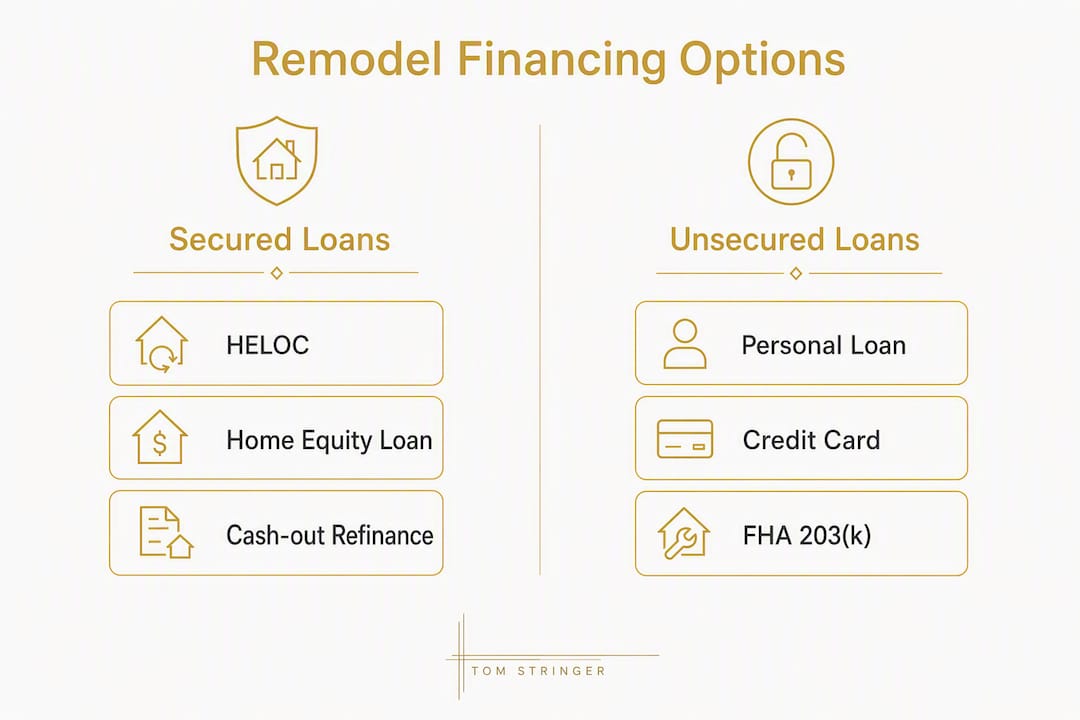
When secured beats unsecured: If your project exceeds $20,000 and you have solid equity, the rate difference between a HELOC or home equity loan and a personal loan is substantial enough to justify the added paperwork and collateral risk. For projects under $15,000 with a fast timeline, the speed and simplicity of a personal loan often wins.
The right loan isn’t just the one with the lowest rate. It’s the one that fits your project scope, your risk tolerance, and your financial situation. Work through this checklist before you talk to a lender.
Pro Tip: Match the financing shape to the project shape. A fixed-scope project with a known total cost — like a full kitchen remodel — fits a fixed-rate lump sum (home equity loan or personal loan). A phased project where costs emerge over time — like a whole-house renovation done in stages — fits a HELOC or line-based product where you draw only what you need.
Knowing the rate range is useful. Knowing what that rate means for your monthly payment on a real project is what actually helps you decide.
Equity-secured products (HELOC, home equity loan, cash-out refinance) generally carry lower rates than unsecured alternatives because your home backs the loan. Personal loans from banks and credit unions typically run 8%–36% APR depending on creditworthiness. Credit cards carry ongoing APRs of 20%–30%+ once a promotional period ends. Renovation mortgages (FHA 203(k), HomeStyle) price close to conventional mortgage rates, which vary with the broader market.
| Project | Typical Budget | Financing Options That Fit | Estimated Monthly Payment (example) |
|---|---|---|---|
| Flooring refresh (1,200 sq ft) | $8,000–$15,000 | Savings, personal loan, 0% card | $180–$320/mo on a 5-yr personal loan |
| Bathroom remodel | $15,000–$40,000 | Personal loan, HELOC, home equity loan | $300–$700/mo depending on rate and term |
| Full kitchen remodel | $30,000–$80,000 | HELOC, home equity loan, cash-out refi | $400–$900/mo on a 10–15 yr equity product |
| Whole-house renovation | $80,000–$200,000+ | Cash-out refi, FHA 203(k), HomeStyle | Varies widely; rolls into mortgage payment |
For a $100,000 project, a common planning guideline is to keep your total renovation borrowing within 30% of your home’s current value — a buffer that protects equity and keeps lender approval realistic. On a $350,000 home, that means staying under $105,000 in renovation debt.
To keep bathroom project costs in check before you finance, see our guide on reducing bathroom renovation costs — small decisions there can shift your financing tier entirely.
Credit cards fund quickly; personal loans generally take up to about a week; HELOCs, home equity loans, cash-out refinances, and renovation mortgages typically take several weeks due to appraisals and underwriting. because of appraisals, underwriting, and title work. Renovation mortgages can run 6–12 weeks when contractor bids and escrow setup are factored in. If your contractor has a start date in two weeks, a HELOC is not your answer — a personal loan is.
No application needed. Set a dedicated account, fund it over time, and pay contractors directly. The only step is having a clear project budget before you start writing checks.
Apply online (approval in minutes for most), then charge project costs directly. The critical step: set a calendar reminder for the promotional period end date and confirm the payoff amount 30 days before.
The process mirrors a full mortgage application. Expect: income verification, full appraisal, title search, underwriting, and a 3-day rescission period after closing. Total timeline: 4–8 weeks.
These are the most document-intensive options. Here’s what the process looks like:
For an overview of whether an FHA 203(k) loan fits your situation, a lender specializing in renovation mortgages can walk you through the eligibility details specific to your project.
Documents needed for secured applications: government-issued ID, two years of W-2s or tax returns, recent pay stubs, current mortgage statement, homeowners insurance declaration page, HOA approval letter (if applicable), and a detailed contractor bid with scope of work.
Pro Tip: Organized contractor bids are the single biggest factor in speeding up renovation mortgage approvals. A bid that lists labor, materials, and timeline separately — rather than a single lump number — gives underwriters exactly what they need and cuts back-and-forth by weeks.
One of the less-discussed friction points in home renovation financing is the gap between what a lender approves and what a contractor actually delivers. When you’re managing multiple vendors — a cabinet supplier, a tile installer, a plumber, a flooring crew — coordinating draws, invoices, and project milestones across all of them is genuinely complicated.
A full-service remodeler like The Kitchen, Bathroom & Flooring Store consolidates that complexity. One contract covers design, product selection, and installation. One draw schedule. One point of contact for both the project and the financing conversation. That structure maps directly onto how renovation mortgages and HELOC draws work: lenders want a single, clear scope tied to a single contractor, not a patchwork of vendor invoices.
The store’s remodeling packages are built around this principle. From the initial design consultation through product selection — cabinets, countertops, tile, vanities, hardwood, luxury vinyl, carpet — to professional installation, everything runs under one roof. That means the itemized bid a lender needs for a 203(k) or HomeStyle application is already structured correctly, because the project scope is defined from day one.
The practical advantage: A single-contract remodel with a defined scope and a professional draw schedule gives lenders exactly the documentation they need — and gives you a cleaner path from loan approval to completed project.
The store also offers in-house financing options with monthly payment plans, which can work well for homeowners who want point-of-sale convenience without the complexity of a renovation mortgage. That said, we always recommend comparing any in-house financing APR against an external HELOC or personal loan quote — the right answer depends on your equity position and credit profile, and transparency on that point matters to us.
Pro Tip: Before your first lender conversation, schedule a design consultation and get a written scope of work from your remodeler. Lenders respond faster when the project is already defined — and you’ll negotiate from a stronger position when you walk in with a real number, not an estimate.
The best remodel financing option depends on your project size, available equity, credit score, and how quickly you need funds — with equity-secured products offering lower rates and unsecured options offering speed and no collateral risk.
| Point | Details |
|---|---|
| Match loan type to project size | Savings or personal loan for small projects; HELOC or home equity loan for mid-size; cash-out refi or renovation mortgage for large scope. |
| Secured vs. unsecured trade-off | Equity-backed loans carry lower rates but put your home at risk; personal loans and contractor financing cost more but leave your property untouched. |
| Timeline matters as much as rate | Personal loans fund in 1–7 days; HELOCs and equity loans take 2–6 weeks; FHA 203(k) and HomeStyle can run 6–12 weeks from application to first draw. |
| Always budget a contingency | Add 10%–20% to your contractor estimate before deciding how much to borrow — cost overruns are common and lenders won’t advance more mid-project. |
| The Kitchen, Bathroom & Flooring Store | Offers full-service remodel packages with in-house financing options, consolidated contracts, and coordinated draw schedules that simplify the lender approval process. |
Most homeowners focus almost entirely on the interest rate when choosing how to finance a remodel. That’s understandable — but it’s the wrong starting question. The more important question is: what happens if this project runs over budget or your income changes mid-renovation?
For a cosmetic-only remodel — new flooring, a bathroom refresh, updated cabinet hardware — putting your home on the line with a HELOC or home equity loan is a risk that rarely matches the reward. A personal loan costs more in interest, but if something goes sideways, your house isn’t the collateral. That trade-off is worth paying for.
For a value-adding project — a full kitchen remodel, a primary bathroom renovation, a whole-house flooring replacement — the math shifts. These projects have documented ROI at resale, and using equity to fund them is a defensible financial decision. The key is being honest about which category your project actually falls into, not which category you’d like it to fall into.
One thing professional remodelers see constantly: homeowners who negotiate hard on contractor financing without ever checking what an external lender would offer. Contractor financing is convenient, but convenience has a price. Pull one HELOC quote and one personal loan quote before you sign any point-of-sale financing agreement. Five minutes of comparison can save hundreds of dollars a year in interest.
Financing a remodel is one challenge. Finding a contractor who delivers on the project is another. The Kitchen, Bathroom & Flooring Store handles both under one roof — no juggling multiple vendors, no mismatched draw schedules, no surprises when the tile installer and the cabinet crew can’t coordinate.
Our bathroom remodeling packages cover everything from design consultation and product selection to professional installation, with financing options that include monthly payment plans tailored to your budget. Whether you’re refreshing a single bathroom, replacing flooring throughout your home, or taking on a full kitchen renovation, we build a single contract with a clear scope — the kind of documentation that makes lender conversations straightforward.
We serve homeowners in Jacksonville, Saint Johns, and Duval counties. To get started, schedule a free in-home estimate and we’ll walk through your project scope, product options, and financing choices together. Visit our financing page to see current monthly payment plan options, or call us to book your estimate today.
These are the primary sources used throughout this article. Each one covers a specific aspect of home improvement financing in depth.
Your next step: Gather your home’s current market value, your mortgage balance, and a rough project budget before your first lender conversation. Then schedule a free in-home estimate with The Kitchen, Bathroom & Flooring Store — we’ll help you define the project scope clearly, which is the foundation every lender needs before they can give you a real number.
This article provides general information about home improvement financing options and is not financial or legal advice. Loan terms, rates, and program eligibility change frequently. Confirm current details with your lender, a HUD-approved housing counselor, or a qualified financial professional before making borrowing decisions.