
The main carpet padding types are bonded (rebond) foam, synthetic or recycled fiber, rubber, polyethylene, and foam sold as “memory foam.” The best one for your home is the pad that matches your carpet’s warranty and the traffic in each room. It is not the softest or the thickest one on the shelf. Below we walk through each type, what the numbers on a spec sheet mean, and how to choose room by room.
Padding, also called cushion, is the layer between your subfloor and the carpet. According to CRI, it improves comfort, absorbs impact and sound, adds insulation, and helps protect the carpet from wear.
Think of it as the foundation of the carpet system. Comfort is the part you feel, but resilience and support are what keep the carpet looking good in year eight. A carpet laid on a pad that is too soft or too thick can lose its appearance early. Your carpet will thank you for a pad that fits it.
CRI also recommends cushion under carpet in almost every case. The exception is direct glue-down carpet systems, where the carpet is designed to bond straight to the floor.
The Carpet Cushion Council’s July 2024 residential chart lists bonded foam, synthetic fibers, resinated recycled textile fiber, flat and rippled rubber, and polyethylene. Each has different minimum density, weight and thickness characteristics. Here is how they compare in everyday terms.
| Type | What it is | Where it fits | Watch for |
|---|---|---|---|
| Bonded (rebond) foam | Polyurethane foam scraps fused together, often multicolored | Most rooms in most homes | Density and thickness vary a lot between grades |
| Synthetic or recycled fiber | Felt-like pad from synthetic or recycled textile fibers | Firm support, many traffic levels | Confirm density against the carpet warranty |
| Rubber (flat or rippled) | Dense rubber, sold flat or with a waffle pattern | High-traffic areas, firm feel | Heavier and denser by design |
| Polyethylene | Polyolefin-based cushion | Specific applications listed by the carpet maker | Lower density figure in the council table |
| “Memory foam” | A foam construction, not a separate universal material | Bedrooms and lightly used rooms | Ask for density, thickness and warranty |
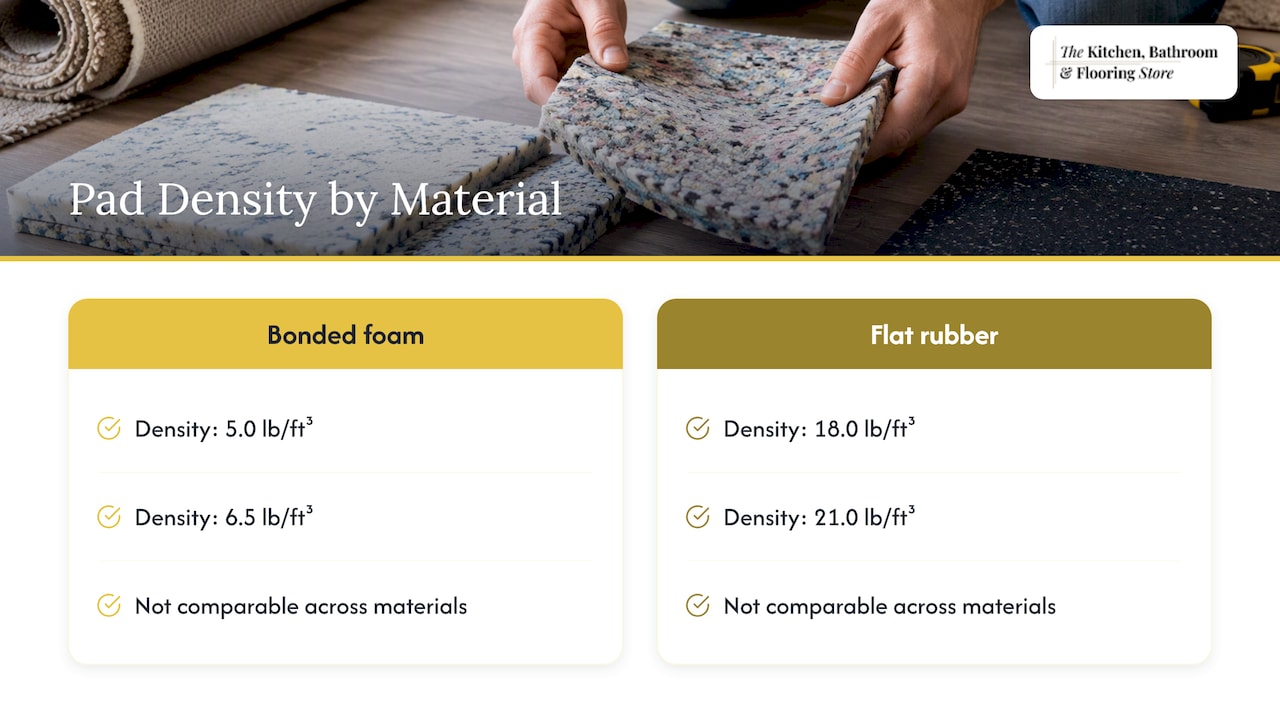
Bonded polyurethane foam is the pad most homeowners end up with, and for good reason. It comes in many grades, so it can be specified for a bedroom or a family room. The Carpet Cushion Council table shows bonded polyurethane foam at 5.0 lb/ft³ and 3/8 inch minimum for Class 1 traffic, and 6.5 lb/ft³ and 3/8 inch for Class 2.
That is why two pads both called “rebond” can feel and perform very differently. The density number is what separates a basic grade from a durable one.
Fiber pads are firm and stable. The same council table lists synthetic fibers at 6.5 lb/ft³. Because they hold their shape, they suit rooms where you want the carpet supported without much bounce.
Rubber is the dense option. The council table gives flat rubber at 18.0 lb/ft³ for Class 1 and 21.0 lb/ft³ for Class 2. You will not compare that number directly with foam, because the materials are measured differently. Rubber feels firm underfoot, which is exactly what stairs and busy corridors call for.
Polyethylene appears in the council table at 3.0 lb/ft³. It is a less common residential choice. If an installer proposes it, check that your carpet manufacturer accepts it.
Memory foam pad is popular for its plush step. But it is a foam construction, not a separate type with its own standards. Before you pay extra, confirm its density, thickness, warranty and, most important, that your carpet manufacturer allows it. Soft is not always supported, and this is where many warranty problems begin.
If you are weighing the two, here is the practical answer.
CRI notes that heavy-traffic rooms need firmer, thinner support than bedrooms or lightly used dens. So a soft pad that feels wonderful in a primary bedroom should not simply be carried into the hallway. Compare the spec sheets, not the labels.
This is the most common expensive mistake: picking pad by thickness alone. CRI’s FAQ corrects the misconception directly. Cut pile generally needs firm cushion no thicker than 7/16 inch. Berber and most commercial carpet generally need very firm cushion no thicker than 3/8 inch.
Here is a quick reference based on CRI’s guidance.
| Carpet style | Thickness guidance | Feel you want |
|---|---|---|
| Cut pile (plush, textured) | 1/4 to 7/16 inch, at least 6 lb/ft³ density | Firm and resilient |
| Berber, low-profile, many loop carpets | No more than 3/8 inch | Very firm and stable |
| Double-glue installation | Cushion made for that method, no thicker than 3/8 inch | As specified by the carpet maker |
CRI states that most residential applications use cushion no thicker than 7/16 inch and no thinner than 1/4 inch, at 6 lb/ft³ density, always subject to the carpet manufacturer’s specification. That last clause matters. If the carpet maker says 3/8 inch, 3/8 inch it is.
The risk of going too soft or too thick is real. CRI warns that the wrong cushion can cause appearance loss, wrinkling, buckling, seam separation, structural breakdown and warranty problems. If you are choosing between carpet styles first, our guide to Berber vs. plush carpet by room covers how each style pairs with the right pad and what keeps a warranty intact.
Shoppers often ask whether an 8 lb pad beats a 6 lb one, or whether 10 lb is worth it. The number is density, in pounds per cubic foot. Denser foam generally resists compression better, so it holds the carpet up longer.
But density alone is not the whole story. CRI’s general residential guidance is at least 6 lb/ft³ with 1/4 to 7/16 inch thickness for standard cut pile. The Carpet Cushion Council shows that different constructions use different scales: 5.0 and 6.5 lb/ft³ for bonded foam by class, but 18.0 and 21.0 for flat rubber. A “10 lb” label on one material is not comparable to a “10 lb” label on another.
So here is a simple rule. Compare density within the same pad type, then check the result against your carpet’s warranty. If the carpet maker requires a specific density or thickness, that requirement wins over any rule of thumb, including ours.
The traffic pattern in each room should drive the choice. CRI’s guidance points to a firm, resilient, dense cushion for hallways, stairs, living rooms, family rooms and other heavy-use areas. A softer option can be appropriate in bedrooms and lightly trafficked dens.
Carpet and pad work as a matched system. CRI 105, the residential installation standard, says the manufacturer’s recommendations control, and that not following them may void the carpet warranty.
That is why we always start with the carpet. A professional should check whether your carpet is designed for separate cushion, direct glue-down or double-glue installation before any material is ordered. Pad is chosen second, from the range the carpet maker approves.
If anyone in your home is sensitive to smells or has allergies, look for the Green Label Plus logo on the cushion sample. CRI explains that it marks cushion with the lowest possible chemical emissions. CRI also suggests planning ventilation and air exchange for roughly 48 to 72 hours after carpet and cushion are installed. That is worth knowing if you plan a quick move-back after a remodel.
Even the right pad can underperform if it is installed badly. CRI 105 describes the process, and it is a useful checklist when you review a contractor’s scope.
One detail is easy to miss. Pad seams should not line up with carpet seams. CRI 105 calls for cushion seams at right angles to carpet seams, or offset at least 6 inches, with seams butted without gaps. It materially affects how stable your carpet seams stay.
We sell and install flooring, so we see what happens when pad is chosen as an afterthought. Here is our view.
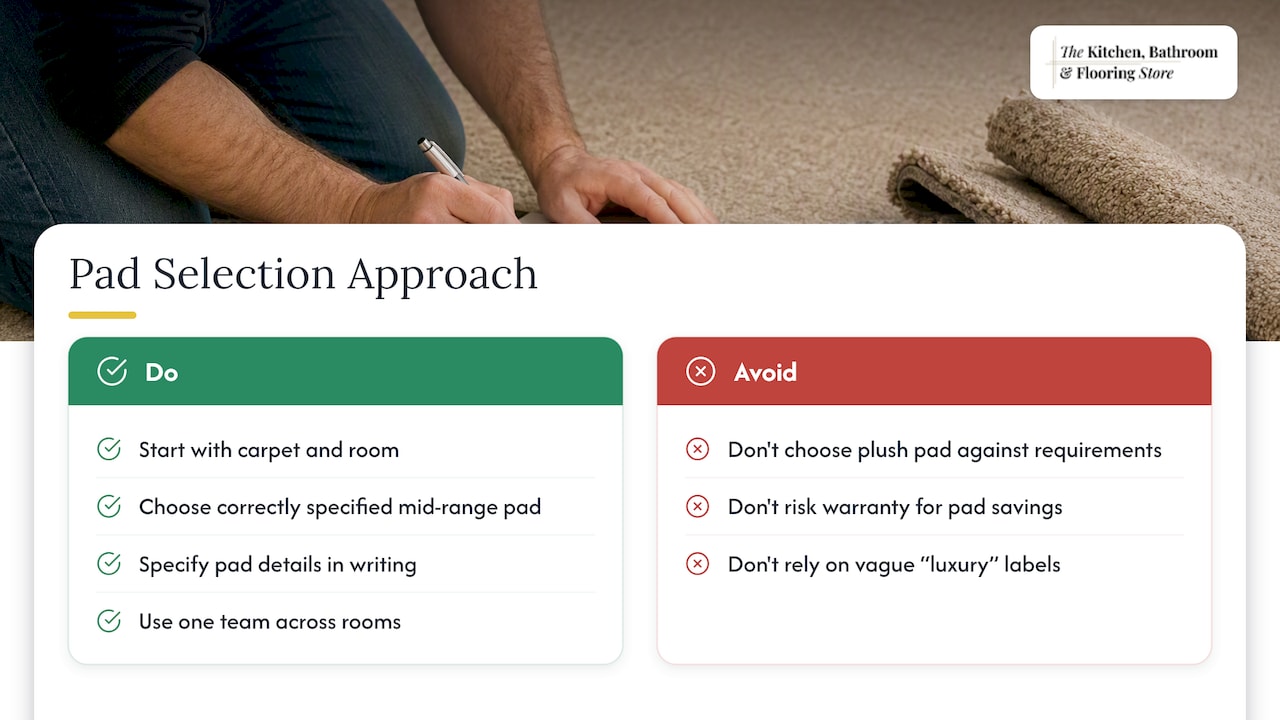
We start with the carpet and the room, not the pad. A homeowner on a budget is usually better served by a correctly specified mid-range pad than by an overly plush one that conflicts with the carpet’s requirements. Spending more on a pad that voids a warranty is the worst version of a bargain.
We also think a quote should be specific. Because we handle design, product selection and installation under one roof, we can put the pad type, thickness and density in writing for every room, so you are not decoding labels like “luxury” on your own. And if you are remodeling more than one space, one team means one schedule and one point of contact instead of coordinating several contractors.
— Anna
The sources we reviewed do not establish a reliable universal installed price for carpet and pad, because costs vary with the carpet, room layout, furniture and old carpet removal, subfloor preparation, stairs and the scope of the contractor. So skip any article that promises one number. Instead, request a written, room-by-room quote that identifies:
CRI advises asking to see the written specification rather than accepting labels such as premium, luxury or memory foam without density and thickness. For a sense of how local flooring bids are put together, our Jacksonville flooring installation cost guide walks through moisture steps and bid tips.
If you are planning new carpet in Jacksonville, St. Johns County or Duval County, come and compare real samples. Our carpet page shows what we carry, and our flooring and installation team can help you choose the carpet and the pad together, then install both. We offer packages tailored to your budget and financing options through monthly payment plans. If you want hardwood or laminate in some rooms, we can quote those at the same visit.
For most rooms, a firm bonded (rebond) foam or fiber pad within your carpet’s approved thickness and density range is a sound choice. CRI’s general residential range is 1/4 to 7/16 inch at 6 lb/ft³. Always confirm it against the carpet manufacturer’s specification.
Soft foam, including pad sold as memory foam, feels the most plush. It suits bedrooms and lightly used rooms best. In hallways, stairs and family rooms, a softer pad can shorten the life of the carpet, so comfort should come second there.
For cut-pile carpet, CRI recommends firm cushion no thicker than 7/16 inch. For Berber, low-profile and many loop carpets, the limit is 3/8 inch with very firm support. Thicker is not automatically better.
CRI recommends cushion under carpet except for direct glue-down carpet systems. Have a professional confirm whether your carpet is made for separate cushion, direct glue-down or double-glue installation before you order materials.
It can. CRI 105 says manufacturer recommendations control, and not following them may void the warranty. Check the warranty terms for the approved pad type, thickness and density before you buy.