
For most kitchens, the smartest pick is plywood boxes paired with either solid-wood or MDF doors. That combination balances strength, finish flexibility, and cost better than any single material on its own. If you’re painting your doors on a budget, MDF gives you a smoother, more affordable surface than solid wood. If you’re outfitting a wet bathroom or a hard-use commercial-style kitchen, stainless steel or high-pressure laminate resists moisture better than almost anything else on the market. Cabinet-grade plywood, specifically, can keep a box functional for 20 to 30 years under normal household use, which is why so many cabinetmakers treat it as the default structural choice.
Here’s the shortlist by use case:
Everything below explains why, and where each material earns its place in your remodel.
Plywood boxes paired with solid-wood or MDF doors deliver the strongest balance of durability, cost, and finish flexibility for most kitchen and bathroom remodels.
| Point | Details |
|---|---|
| Best all-around combo | Plywood boxes with solid-wood or MDF doors balance strength, cost, and finish options. |
| Plywood lifespan | Cabinet-grade plywood commonly lasts 20 to 30 years under normal household use. |
| MDF needs protection | MDF paints smoothly but swells with moisture; seal edges and pair with a plywood box. |
| Particleboard is short-term | Particleboard cuts upfront cost but often lasts only 5 to 10 years once exposed to water. |
| Get expert guidance | The Kitchen, Bathroom & Flooring Store offers design consultations and material samples to help you pick the right combination before installation. |
Before you compare brands or styles, you need to understand what’s actually inside a cabinet. Every cabinet has two separate material decisions: the box (the structural shell) and the doors/drawer fronts (what you see and touch). Homeowners often shop by door style and forget that the box substrate determines how long the whole cabinet survives. Getting both decisions right, rather than focusing only on the finish you like, is the difference between cabinets that last two decades and ones that sag or swell within five years.
Solid wood cabinetry uses actual lumber, not an engineered core, and the species you’ll see most often are oak, maple, cherry, and walnut. Each brings a different grain pattern, hardness, and price point, but they share the same core appeal: you can sand and refinish solid wood repeatedly over its life, which engineered materials can’t match.
Solid wood tends to move with the seasons. In a humid Florida bathroom or a kitchen near a dishwasher, that expansion and contraction can eventually cause warping or joint gaps unless the wood is properly sealed and acclimated before installation. That’s why solid hardwood works best on island faces, furniture-style pieces, and face frames rather than as a full wet-area solution.
Pro Tip: Ask your installer to seal all six sides of a solid-wood door, not just the front and edges. Unsealed backs are the most common cause of warping we see in humid climates.
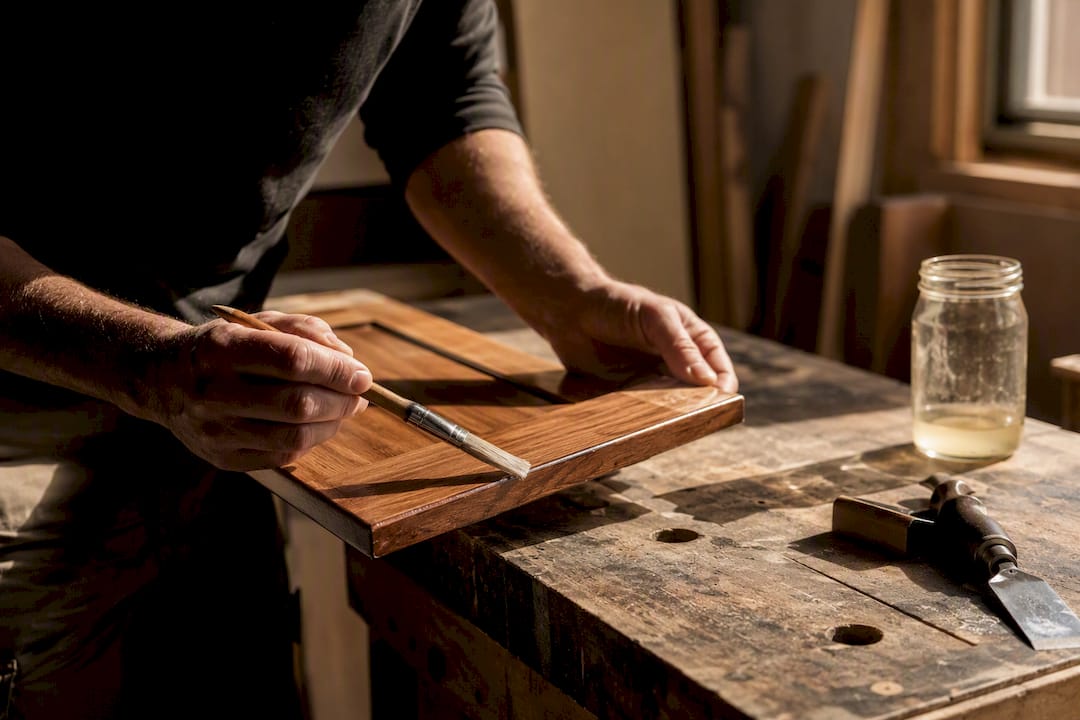
Solid wood cabinets, properly maintained, commonly last 30 years or more, which is part of why homeowners treat the material as a long-term investment rather than a quick upgrade.
Plywood is the material most cabinetmakers reach for when building the box itself, and for good reason. Furniture-grade or cabinet-grade plywood, sometimes Baltic birch, uses thin cross-grained veneer layers glued under pressure with no internal voids. That alternating grain pattern gives it excellent screw-holding strength and moisture resistance compared to particleboard.
When you’re comparing suppliers, don’t assume “plywood” means the same product everywhere. Ply count, core type, and void quality vary widely between a big-box stock cabinet and a custom shop.
Pro Tip: Ask your supplier three questions: how many plies, what core type (veneer core versus MDF core), and whether they inspect for internal voids. A 13-ply veneer-core box will outlast a 5-ply version with visible gaps.
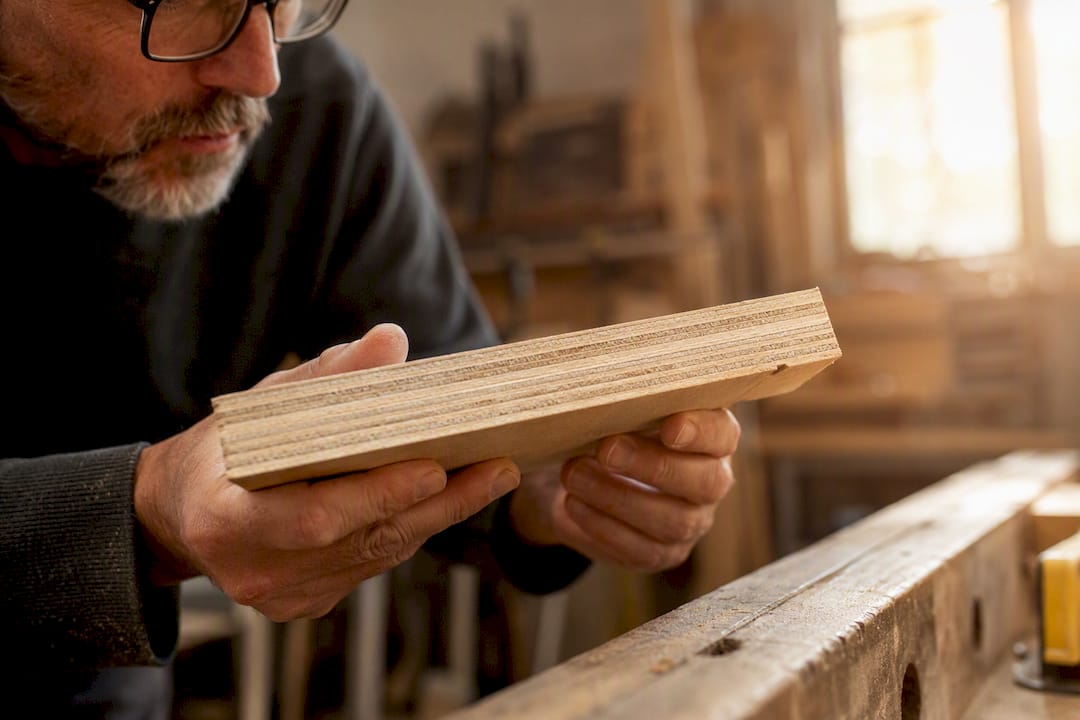
MDF (medium-density fiberboard) and particleboard both start as wood fibers pressed with resin, but they’re not interchangeable. MDF uses finer fibers pressed more densely, which is why it’s the industry standard for smooth painted doors that need to route cleanly into decorative profiles without showing grain. Particleboard uses coarser wood chips and costs less, but it’s noticeably weaker and swells faster when exposed to water.
Never install unsealed MDF or particleboard under a sink or near a dishwasher without edge protection. Both materials swell permanently once water penetrates the core, and painted MDF holds up far longer when it’s built on a plywood box rather than a full particleboard shell.
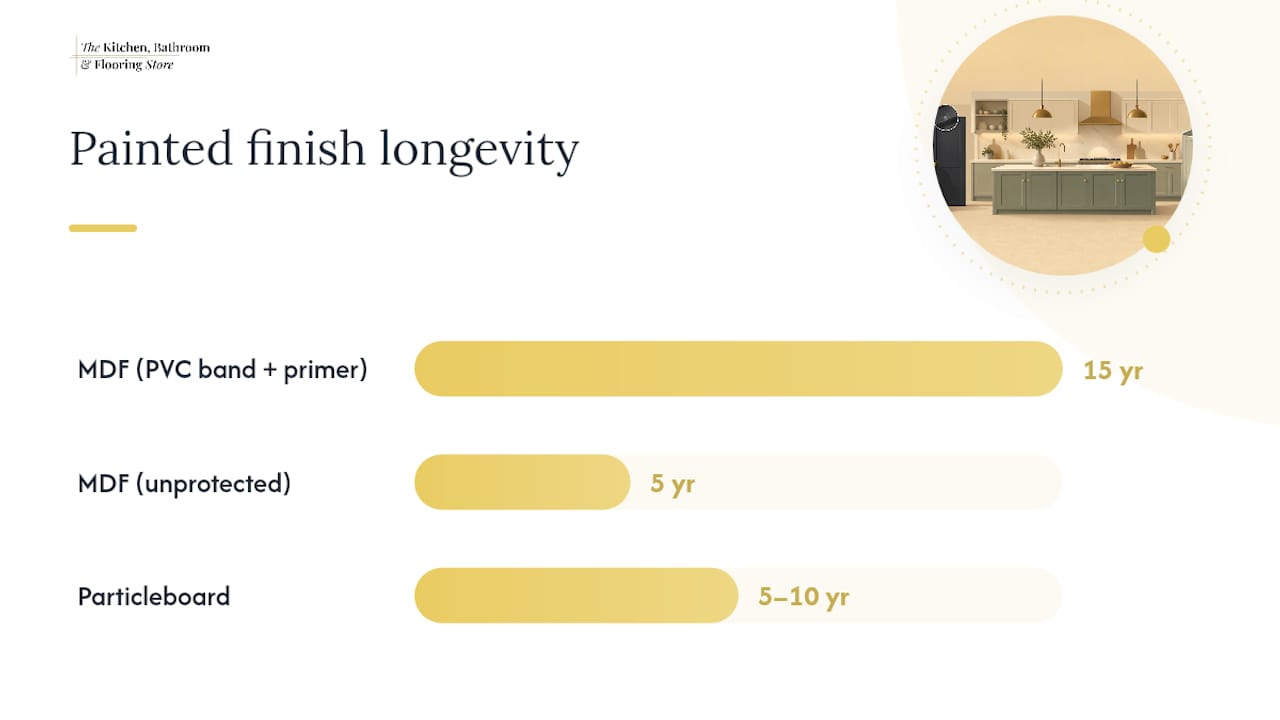
Pro Tip: Specify PVC or hardwood edgebanding on every exposed MDF edge, and confirm your painter uses a primer designed for engineered wood. That combination is what separates a five-year paint job from a fifteen-year one.
Veneer is a thin slice of real wood, often less than a millimeter thick, bonded to a stable engineered core like plywood or MDF. You get the visual warmth of oak or walnut grain without the weight, cost, or seasonal movement of solid lumber.
Veneer shines on tall pantry doors or wide island panels, where a solid-wood equivalent would be prone to cupping. Prefinished veneer panels, cured in a factory rather than sprayed on-site, tend to hold up more consistently than field-finished versions.
Pro Tip: If matching grain across multiple doors matters to you visually, ask your cabinetmaker to book-match veneer sheets from the same flitch. It’s a small request that makes a big difference on a large kitchen wall.
Three engineered surface families dominate the budget-to-midrange market, and homeowners often lump them together even though their durability differs quite a bit. Thermally fused laminate (TFL) bonds a printed layer directly to particleboard or MDF in a single step. Thermofoil vacuum-wraps a vinyl film over an MDF profile. HPL is built differently: multiple layers of kraft paper are fused with a decorative sheet under extreme heat and pressure exceeding 1,000 PSI, then bonded to a substrate afterward.
For a rental property, secondary kitchen, or laundry room cabinet, TFL or thermofoil often makes financial sense. For a primary kitchen that sees daily wear, HPL is the stronger long-term surface.
Stainless steel cabinets aren’t just for restaurant kitchens anymore. They’re fully waterproof, resist heat near ranges, and wipe clean with almost no effort.
If you’re chasing an industrial look or outfitting a wet mudroom, stainless holds up in ways wood-based materials simply can’t.
A few newer or less common materials are worth asking about if sustainability or a modern slab look matters to you. Reclaimed wood offers genuine visual character but needs to be re-milled and stabilized properly to avoid warping once it’s back in service. Acrylic, PET film, and thermo-structured surfaces (TSS) are appearing more often on modern slab-door kitchens, delivering a factory-consistent high-gloss finish that’s typically more durable than a site-sprayed lacquer.
If sustainability is a priority, ask your cabinetmaker for formaldehyde-free adhesive certifications and documented wood provenance. Those two questions filter out a lot of lower-quality suppliers fast.
Maintenance expectations vary a lot by material, and mismatched expectations are where homeowners get frustrated. Solid wood needs occasional resealing and can be refinished multiple times over 30-plus years. Plywood boxes, if kept dry, commonly run 20 to 30 years without structural issues. MDF painted doors hold up well in dry kitchens but need repainting or edge repair sooner if moisture gets involved. Particleboard is the shortest-lived option, lasting fewer years in a heavily used kitchen once any water exposure occurs.
Pro Tip: Get your finish specifications in writing before installation, including primer type, number of coats, and sealant brand. If a warranty dispute ever comes up, that document is your proof of what was promised.
Run through this checklist before you sign off on any material:
When you’re talking to a supplier or installer, ask these questions directly:
Watch for red flags: vague answers about “wood composite” without naming the substrate, base cabinets built entirely from low-grade particleboard, or a warranty that doesn’t specify what’s actually covered. If you’re weighing solid-wood interior doors against engineered alternatives for other parts of your home, this comparison breaks down similar trade-offs in materials and cost.
You don’t have to become a cabinetmaker to get this right. At The Kitchen, Bathroom & Flooring Store, our design consultants walk you through real material samples in the showroom, not just photos, so you can feel the weight of a solid-wood door next to an MDF one before you commit. We handle cabinet selection, countertop pairing, and installation under one roof, which means no coordinating between a cabinet supplier and a separate contractor.
If you’re weighing whether a single-vendor approach fits your project, our guide to working with one contractor walks through what that coordination actually looks like day to day. Reach out to schedule a design consultation and see samples in person.
The biggest error homeowners make is choosing an all-MDF cabinet for a wet kitchen because the price looked right. A close second: focusing entirely on door finish while the installer quietly downgrades the box substrate. Ask about the box first, every time.
You could spend weeks comparing substrate specs across five different suppliers, or you could get all of it, cabinets, countertops, and installation, coordinated by one team that already knows which combinations hold up in Florida humidity. The Kitchen, Bathroom & Flooring Store builds full bathroom remodeling packages that pair moisture-rated cabinetry with the right countertop and flooring from the start, backed by financing options if you’d rather spread the cost over monthly payments. If you’re also considering new flooring alongside your cabinets, our flooring selection pairs naturally with the same consultation. Schedule a design consultation with our showroom team to compare real material samples and get a project estimate before you commit to anything.