
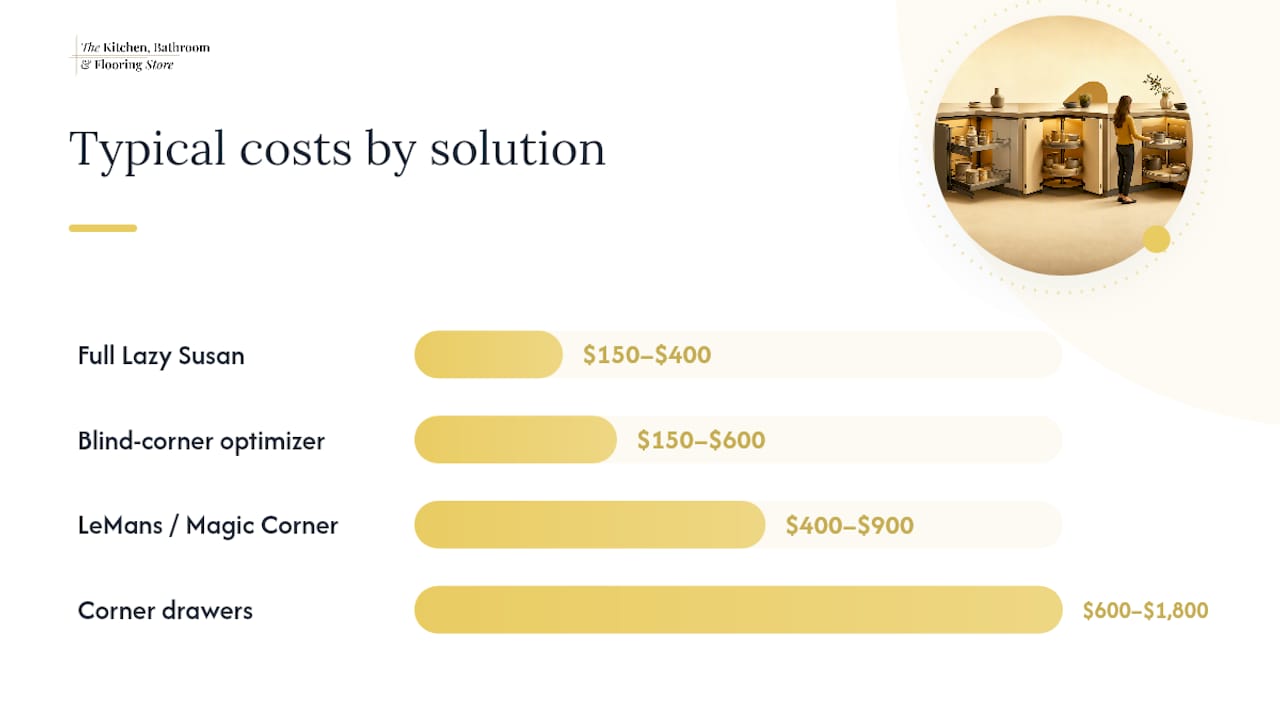
Match the fix to your cabinet type, and the frustration mostly disappears. Blind corners almost always need a pull-out optimizer. True angled corners usually work best with a Lazy Susan or corner drawers. L-shaped cabinets with two doors do best with a three-quarter or pie-cut Lazy Susan. Here’s the quick map before we get into the details:
Notice the pattern. The cheapest fixes go into cabinets you already have. The pricier ones usually mean pulling the old hardware out and, in some cases, rebuilding the corner box itself. Keep reading, and you’ll know exactly which category your kitchen falls into before you spend a dollar.
The single most important measurement depends entirely on which type of corner cabinet you have, so start by naming that type correctly. Get this wrong and you’ll order hardware that never fits.
A blind corner cabinet has one visible door on the front of the cabinet run, but a chunk of usable space extends sideways behind the wall of the adjacent cabinet, completely out of sight. You reach in, and your arm disappears into darkness. This dead zone is why blind corner cabinets almost always require a filler panel or corner post between the corner door and the next cabinet, just to make sure the door swings clear.
An angled or diagonal corner cabinet looks completely different. It has one door set at a 45 degree angle across the corner, and behind that door sits a roughly triangular or pie-shaped cavity. There’s no hidden void here. Everything inside is reachable in theory, which is exactly why a Lazy Susan works so well in this shape.
L-shaped corner cabinets with two doors meet at a 90 degree angle, one door on each face of the cabinet run. Open both, and you’re looking straight into the corner from two directions. This is a different animal than the blind version, and it’s the shape most commonly retrofitted with a three-quarter Lazy Susan.
Corner drawer stacks are the newest style you’ll see in remodels, with the entire corner built as a stepped or diagonal drawer bank instead of a door-and-shelf combination. They’re rare in older homes because they require the cabinet box itself to be built for it.
Once you know which type you’re looking at, note four things: the width of the door opening, the interior depth of the cabinet at its deepest point, the depth of any adjacent cabinet wall creating a blind zone, and which side (left or right) that blind zone sits on. Measurement mistakes around handedness are the number one reason people order a pull-out system that arrives and won’t fit.
Pro Tip: Take two photos before you shop: one straight into the open cabinet, one from the side showing how far the blind space extends behind the adjacent cabinet wall. Measure the door opening width and interior depth, and jot down how close the nearest appliance door swings to the corner. Bring that single photo and those three numbers to any showroom or installer, and you’ll cut your consultation time in half.
Every corner fix trades off accessibility, cost, and how much of the cabinet’s total volume you can actually reach. Here’s what’s out there, starting with the most common.
The full Lazy Susan is the easiest, cheapest fix for a true angled corner cabinet. Two or three circular shelves rotate 360 degrees on a center pole, so you spin the whole assembly to bring items to the front. It’s DIY-friendly, typically installs in under an hour, and costs $150 to $400 for a quality unit. The tradeoff is that round shelves waste some square footage in a corner cabinet’s straight-sided cavity, and heavier items tend to slide during the spin if the shelf lip is shallow.
Half-moon and pie-cut Lazy Susans solve the same problem for L-shaped, two-door cabinets. Instead of one full circle, you get D-shaped or pie-shaped shelves that rotate independently or in a linked pair. Lazy Susans in general remain the most cost-effective corner fix on the market, though a pie-cut model won’t capture quite as much cubic space as a full circle would in an angled cabinet.
Blind-corner optimizers, like Rev-A-Shelf’s Girasolo and polymer half-moon units, are built specifically for the hidden void in blind cabinets. They use a pivoting arm or sliding track that swings the shelf out of the blind zone and into the open door frame, then swings back when you close the door. Rev-A-Shelf’s product range includes soft-close versions, wire baskets, and solid-bottom trays in multiple sizes and finishes, so fit and budget flexibility are both decent here. These run $150 to $350 for the entry-level polymer models and up to $600 for soft-close Girasolo units, and most handy homeowners can install one in an afternoon.
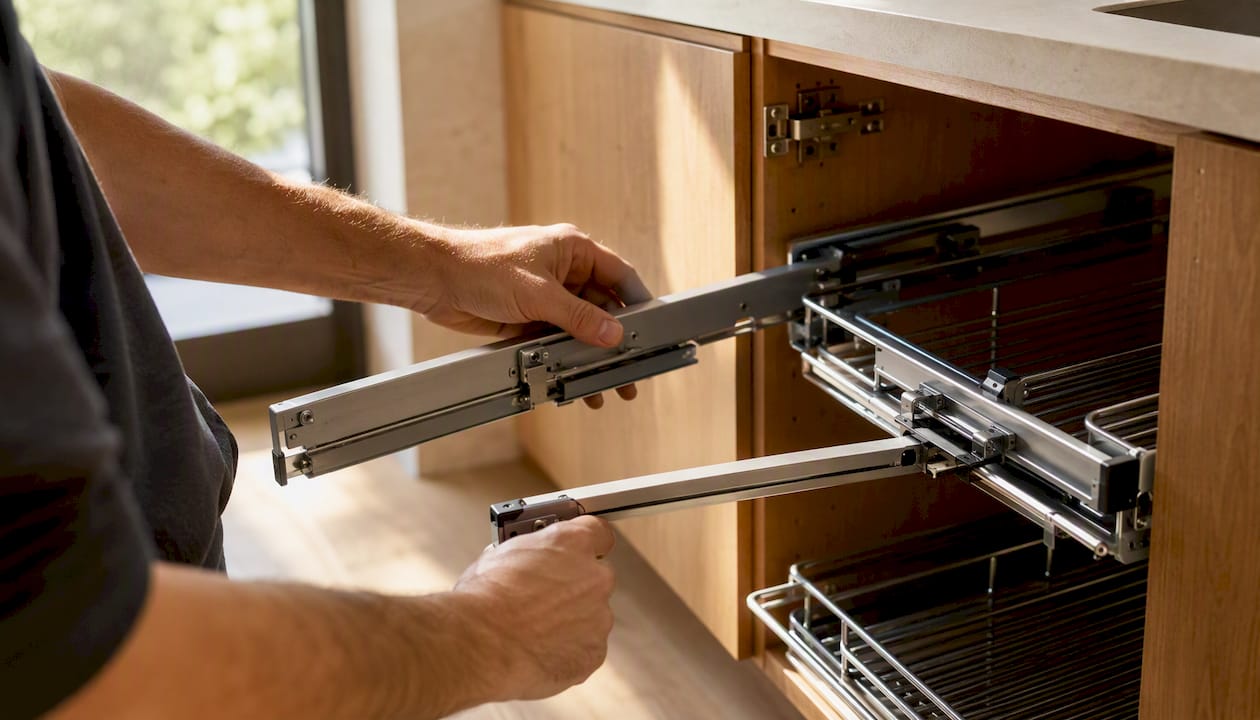
LeMans-style and Magic Corner pull-out systems are the premium answer for blind corners. Picture two or three wire baskets mounted on a pivoting frame that rolls the entire assembly out of the cabinet on rails, bringing nearly everything in the blind void into full view at once. These systems are widely regarded as the top-performing solution for blind corners because they retrieve more usable space than a half-moon optimizer, but that performance comes at a price. Expect $400 to $900 for the hardware alone, plus installation, since these units mount to the cabinet floor and often need reinforcement to handle the weight of a fully loaded basket.
Corner drawers skip rotating mechanisms entirely. The drawer boxes themselves are cut at an angle or stepped to follow the corner, and you just pull straight out like any other drawer. Nothing spins, nothing pivots, and there’s no learning curve. The catch is that corner drawers are almost never a retrofit. They require the cabinet box to be built for them, which means a rebuild, not a simple hardware swap, running $600 to $1,800 per cabinet.
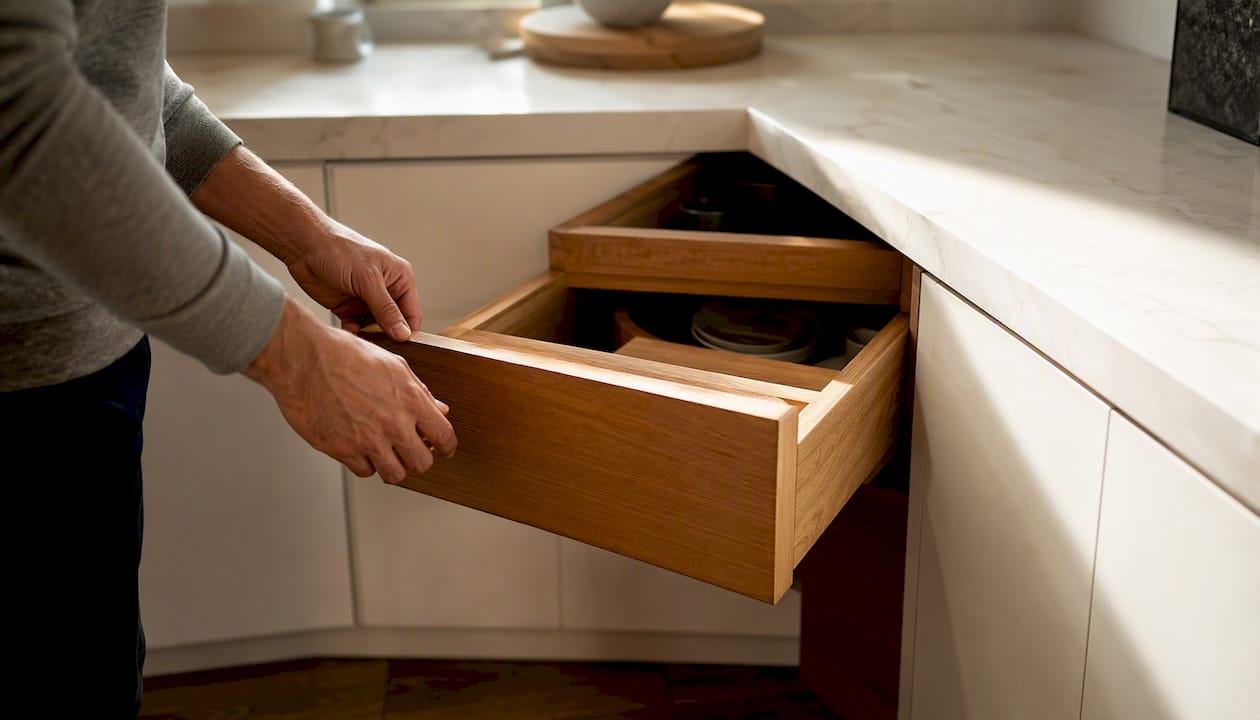
Angled-front cabinets with a single diagonal door and fixed shelves are the low-cost, low-mechanism option. No moving parts means nothing to break, but you lose easy access to the back corners of each shelf unless you’re comfortable reaching in and feeling around.
A corner pantry converts the whole troublesome cavity into a tall, walk-in style storage column instead of fighting the corner’s shape at all. Houzz lists this among the practical alternatives for kitchens where a mechanical retrofit doesn’t make sense, particularly in smaller layouts where the corner’s awkward geometry isn’t worth solving with hardware at all.
| Solution | Best for | Retrofit difficulty | Approx. cost range | Space efficiency | Durability & maintenance | Clearance considerations |
|---|---|---|---|---|---|---|
| Full Lazy Susan | Angled/diagonal corners | DIY-friendly | $150–$400 | Moderate (round shelf in square space) | Low maintenance; check pole and bearing yearly | Needs full door swing clearance |
| Half-moon blind optimizer | Blind corners, budget-conscious | DIY-friendly | $150–$600 | Moderate to good | Occasional pivot lubrication | Filler panel width must be correct |
| LeMans/Magic Corner pull-out | Blind corners, maximum access | Pro recommended | $400–$900 | High | Check basket rails periodically | Needs adjacent appliance clearance |
| Corner drawers | New builds/rebuilds, everyday ease | Pro recommended (rebuild) | $600–$1,800 | High | Very low; standard drawer glides | Requires new cabinet box |
| Corner pantry | Small kitchens, awkward corners | Pro recommended (rebuild) | $500–$1,800+ | High (vertical storage) | Standard shelving upkeep | Depends on adjacent wall/appliance layout |
Retrofit makes sense when your existing cabinet box is sound and you’re only swapping the internal mechanism. Rebuild makes sense when the cabinet type itself is the problem, not just the hardware inside it. If you have a blind corner and want more reach, a LeMans pull-out retrofit solves it in a day. If you have a blind corner and want a completely different kind of storage, like drawers, you’re rebuilding the box.
| Path | Typical cost range | Typical timeline | Notes |
|---|---|---|---|
| Lazy Susan retrofit | $150–$400 | 1–2 hours | Simplest DIY option; no structural changes |
| Half-moon optimizer retrofit | $150–$600 | 2–4 hours | Requires accurate handedness and filler panel check |
| LeMans/Magic Corner retrofit | $400–$900 | Half day to full day | Often needs pro mounting for weight support |
| Corner drawer rebuild | $600–$1,800 | 1–3 days | New cabinet box required; contractor territory |
| Angled-front to corner pantry rebuild | $500–$1,800+ | 2–5 days | May involve adjacent cabinet reconfiguration |
Before ordering anything, walk through a short pre-installation checklist. Confirm the door opening width and interior depth match the hardware’s listed specs exactly, not approximately. Check for a corner post or filler panel between the door and the adjacent cabinet, since the wrong filler panel width is one of the most common reasons a pivoting mechanism binds against an appliance handle or door. Confirm the weight rating on any pull-out basket system against what you actually plan to store, particularly for cast iron or small appliances. And walk the swing arc of any nearby dishwasher or oven door to make sure it clears the fully open corner cabinet door.
Heavier pull-out systems sometimes need reinforcement blocks mounted to the cabinet carcass rather than just the face frame, since the cabinet floor alone may not support a fully loaded basket over years of use. That’s a detail worth asking about directly if you’re getting quotes, because it separates a lasting install from one that sags within a year.
Watch for a few red flags when comparing installer quotes. Be wary of any quote that skips an on-site measurement entirely, since blind corner dimensions vary enough between cabinet runs that a phone estimate is close to guesswork. Be skeptical of “one-size-fits-all” hardware claims, since handedness and door opening width are cabinet-specific, not universal. And if a quote gives you a vague total without breaking out hardware cost versus labor, ask for the split before you sign anything. If your remodel touches more than just the corner, our guide to space planning for kitchens covers how appliance placement and cabinet runs interact across the whole layout.
Clear stackable bins and a simple non-powered turntable solve most day-to-day corner cabinet frustration for less than $50, and you don’t need any tools. This is the move if you’re renting, testing out a layout before committing to hardware, or just tired of digging blindly into the back of a cabinet tonight.
Design experts consistently point to bins, turntables, and grouping items by purpose as the highest-return, lowest-cost fixes available, and the data backs that up: a small investment in clear bins and a basic turntable delivers a disproportionate usability gain compared to what you’d spend on hardware. If you want a slightly more custom fix without committing to a mechanism, our home organization partners cover a range of affordable, quick-install options worth a look.
Pro Tip: Build your own shallow slide-out shelf with a piece of half-inch plywood cut to fit the cabinet’s interior width, then attach four adhesive-backed nylon glide pads to the underside. It won’t have the polish of a manufactured drawer system, but it slides smoothly on melamine or laminate shelving and costs under $15 in materials.
These fixes are genuinely useful, but be honest about what they are. Bins and turntables improve visibility and organization inside the space you already have. They don’t create new access to a blind corner’s hidden void the way a pull-out optimizer does. If you’re still losing items to the back wall after adding bins, that’s your sign the cabinet needs a mechanical fix, not another container.
The fastest way to choose is to identify your cabinet type, decide what you actually store in that corner, confirm your measurements, and match those answers to the mechanism built for that job. Skip a step and you risk ordering hardware that looks right online but doesn’t fit your kitchen.
If you’re getting quotes from a remodeler or installer, bring a short list of questions with you. Ask which side the blind zone is on and whether they’ve confirmed it on-site, not from a floor plan. Ask whether a filler panel or corner post is needed and, if so, what width. Ask about the weight rating on any pull-out basket and whether soft-close hardware is included or an upgrade. Ask what warranty covers the mechanism versus the cabinet box itself. And ask directly whether the install requires any cabinet modification, since that changes both your cost and timeline.
Hire a pro when you’re installing a LeMans or Magic Corner system, when the job involves structural changes to the cabinet box (corner drawers, angled-front conversions), or when plumbing or countertop work near the corner is part of the project. Designers who focus on daily usability over raw capacity tend to steer clients toward the mechanism that gets used every day, not the one that theoretically holds the most.
The corner cabinet you’ll actually use is the one that brings items to you, not the one that simply claims the most cubic feet. We’ve seen plenty of kitchens where a homeowner installed the biggest, most elaborate pull-out system available, only to find they still avoided that cabinet because reaching the back basket required crouching and craning. Accessibility beats capacity almost every time.
That’s the lens we bring when we measure a kitchen for a remodel. Because The Kitchen, Bathroom & Flooring Store handles design, sourcing, and installation under one roof, we can walk into your kitchen, take the measurements ourselves, and recommend the mechanism that actually fits your cabinet’s handedness, depth, and clearance, rather than guessing from a floor plan. Getting the corner right often comes down to details most people never think to check until the hardware arrives and doesn’t fit.
You get one measurement visit, one design conversation, and one installation crew instead of juggling separate hardware orders, a handyman, and a cabinet maker. That’s the real advantage of working with The Kitchen, Bathroom & Flooring Store on a corner cabinet fix: no guessing at specs online, no coordinating multiple vendors, and no returning a $500 pull-out system because the blind zone measurement was off by an inch.
We start with an in-home measure, where we identify your cabinet type, note handedness and clearance, and walk you through which mechanism actually fits your space and your budget. From there, our design team helps you choose between a retrofit fix and a full cabinet rebuild if your kitchen calls for it, and our installation crew handles the mounting, reinforcement, and finishing work so the mechanism operates the way it’s supposed to for years, not months.
Here’s what’s included when you work with us on a corner cabinet fix:
If your corner cabinet issue is really part of a bigger kitchen refresh, our cabinet team can walk you through cabinet options for the whole kitchen, not just the corner, and we offer financing plans if you’d rather spread the cost over time. Schedule an in-home measure or stop by the showroom to see the hardware in person before you decide.
Match the mechanism to your cabinet type: blind corners need a pull-out optimizer, angled corners need a Lazy Susan, and everyday ease usually beats maximum capacity.
| Point | Details |
|---|---|
| Identify cabinet type first | Blind, angled, L-shaped, and drawer-style corners each need a different fix, so classify yours before shopping. |
| Measure before you buy | Door opening width, interior depth, and blind-zone handedness prevent the most common ordering mistakes. |
| Budget fixes exist first | Clear bins and turntables cost under $50 and solve visibility issues without any hardware install. |
| Know your cost band | Retrofits run $150 to $900; rebuilds like corner drawers or a pantry run $600 to $1,800 or more. |
| Get a turnkey measure | The Kitchen, Bathroom & Flooring Store measures, sources, and installs corner solutions in one visit, no juggling separate vendors. |
These sources back the cost ranges, mechanism details, and installation guidance covered above, and they’re worth a look if you want to dig into product specs or technical details yourself.