
Most Jacksonville homeowners should plan around $65 per square foot installed, with typical projects landing between $28 and $140 per square foot depending on slab tier and finish. That range usually covers the slab and basic installation only. Sink cutouts, specialty edges, and old countertop removal are commonly billed separately, so ask any fabricator for a full itemized quote before you commit to a number.
TL;DR:
- Most projects in Jacksonville cost around $65 per square foot installed, but prices vary from $28 to $140 based on slab grade and finish.
- Proper quotes should itemize all costs, including slab, fabrication, template, edges, seams, removal, installation, and warranty details, not just a per-square-foot price.
- Additional costs for edge profiles, slab thickness, pattern complexity, and specialty features should be explicitly listed as separate line items.
- Most countertop projects in Jacksonville are straightforward, but permits may be required for plumbing or electrical modifications, and delays often stem from slab availability or cabinet changes.
- Homeowners should request an in-home estimate with an itemized, fully inclusive quote, verify warranty coverage, and consider financing options bundled with full kitchen remodels.
Quartz pricing in Duval County breaks into three rough tiers, and where you land depends mostly on slab grade and finish rather than the size of your kitchen. Builder-grade quartz sits at the low end of the local range, standard mid-tier colors sit near the midpoint, and premium or designer slabs push toward the top.
Using the reported local midpoint, a 25 square foot kitchen (a common galley or small U-shape layout) lands around $1,625 at $65 per square foot before extras. A 40 square foot kitchen, typical for a mid-size L-shape with an island, runs closer to $2,600. A larger 60 square foot kitchen with a full island and peninsula can reach $3,900 at that same midpoint, and considerably more if you choose a premium slab.
Color and pattern matter more than most homeowners expect. A plain white or gray quartz stays near the low or mid tier, while a slab with dramatic movement, gold veining, or a book-matched pattern can jump a project into premium pricing even at the same square footage.

A number like “$65 per square foot” only tells part of the story. Per-square-foot pricing can be misleading because most quotes exclude common extras that show up later as change orders. A proper walk-away quote should itemize every cost before you sign anything.
Add-ons like undermount sinks, waterfall edges on an island, or mitered edges for a thicker look all carry their own ballpark extra costs, and a fabricator who quotes a bare per-square-foot number without mentioning this is leaving room for surprises later.
Pro Tip: Ask for a single walk-away number that includes every line item above, not just a per-square-foot estimate. It’s the only figure you can fairly compare between fabricators.
A typical quartz project in Duval County moves through four stages: initial measure, template visit (once cabinets are set), fabrication at the shop, and installation. Most kitchens move from template to install within one to three weeks, though slab availability and fabricator workload can stretch that window.
Our own permit process guide walks through what triggers a permit for a broader remodel, which is worth a look if your countertop project is part of a larger kitchen update.
Comparing quotes gets easier once you know what to ask for. Use this checklist during any showroom visit or phone call.
Watch for red flags: a quote that only says “from $X per square foot,” no scheduled template visit, or no mention of warranty coverage at all. Two questions tend to expose hidden costs fast: “What is included in this price, and what would cost extra?” and “Who performs the installation, your team or a subcontractor?”
Pro Tip: If a fabricator can’t answer both questions clearly on the spot, treat that as a sign to get a second quote before signing.
We built our showroom around removing the guesswork from quotes like these. Instead of coordinating a slab supplier, a fabricator, and an installer separately, homeowners work with one team from selection through install.
A one-stop remodeler tends to make the most sense when your countertop project touches cabinets, plumbing, or electrical work, since one team managing the whole scope cuts down on scheduling conflicts between separate trades.
Most Jacksonville homeowners financing a quartz countertop do so as part of a larger kitchen remodel rather than a standalone purchase, since bundling countertops with cabinets or flooring often qualifies for better financing terms than a countertop alone. Full-service remodelers, including our own showroom, typically offer monthly payment plans tied to a bundled remodeling package rather than a single line item.
When you’re comparing financing across fabricators, ask three things: what the monthly payment covers, whether there’s a promotional interest period, and whether the financing is tied to the full project or just the countertop. A plan that only covers the slab and fabrication, without installation or extras, can end up costing more once you add the missing pieces back in.
If your project is countertops only, some suppliers offer in-house financing directly through the showroom rather than a third-party lender, which can simplify approval and paperwork. Either way, get the payment terms in writing alongside your itemized quote so you’re comparing full project cost, not just the advertised monthly number.
Warranty terms vary widely between fabricators, and it’s worth confirming exactly what’s covered before you sign. Some quotes include a workmanship warranty on installation but leave manufacturer defects to a separate claims process with the slab producer, which can matter if a seam or edge issue shows up months later.
Maintenance costs for quartz itself stay low compared with natural stone. Manufacturer guidance from Cambria notes that quartz is nonporous and does not require sealing, which saves homeowners the recurring sealing costs that granite or marble typically require. That said, quartz is not indestructible: manufacturers caution against placing hot pans directly on the surface, and while quartz is durable, it is not structural, so proper cabinet support still matters.
Ask whether your quote’s warranty covers just the installation labor or extends to the slab material itself, and for how many years. A fabricator with in-house installation can often offer a longer or clearer warranty since they control both the fabrication and the install, rather than splitting responsibility between two companies.
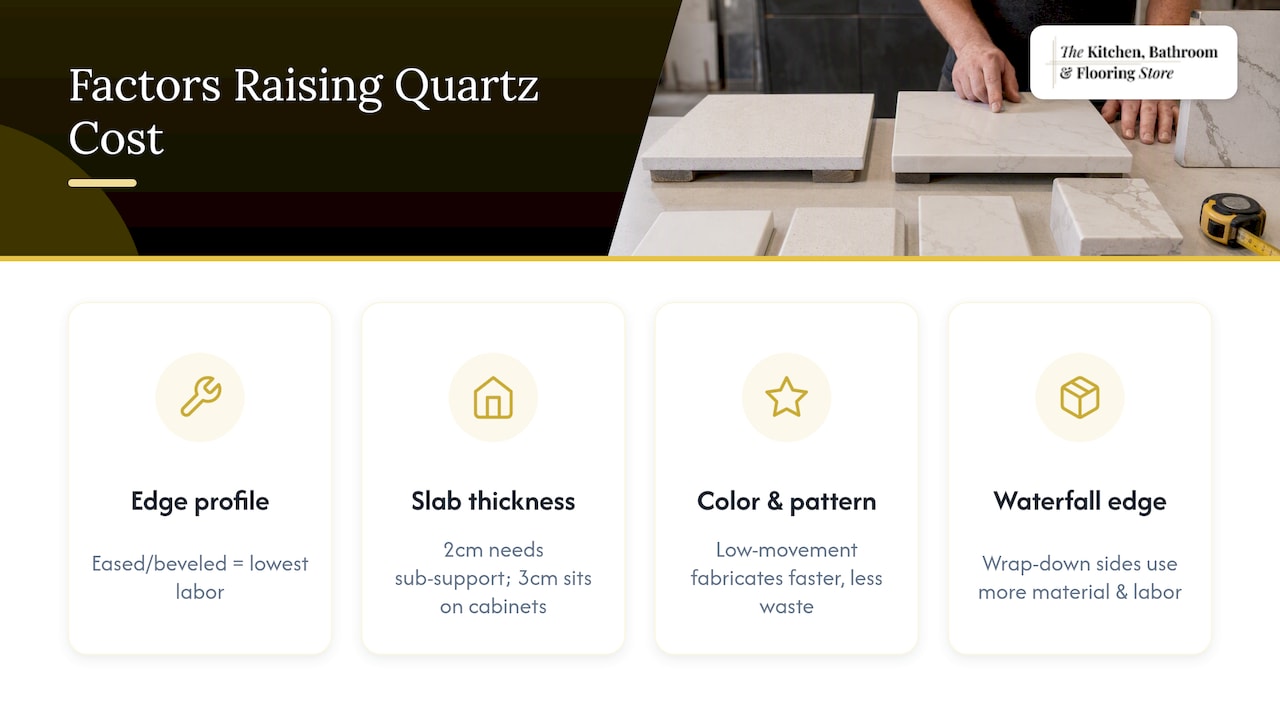
Design choices move the needle on price more than most homeowners expect going in. Edge profile is one of the biggest variables: a simple eased or beveled edge costs the least, while a bullnose, ogee, or mitered edge adds labor and typically raises the per-square-foot cost.
Slab thickness matters too. Thinner 2cm slabs generally need additional support underneath, such as a built-up perimeter or full sub-top, which adds material and labor cost that a thicker 3cm slab, sitting directly on well-leveled cabinets, usually avoids.
Color and pattern complexity round out the picture. A plain, low-movement color fabricates faster and with less waste than a slab with dramatic veining that requires careful matching across seams. Waterfall edges on an island, where the quartz wraps down the side in one continuous piece, also add both material and fabrication time, and should show up as a distinct line item on your quote rather than folded into a vague per-square-foot number.
The biggest mistake we see isn’t picking the wrong slab, it’s shopping on a per-square-foot number that never matches the final invoice. Budget around the itemized total, not the headline figure, and build in a little room for edge and cutout costs. An in-home measure early in the process saves more money than any amount of phone comparison shopping.
— Anna
We handle slab selection, fabrication, and installation under one roof, with financing available through our Kitchen Remodeling Packages. When you request your estimate, ask for an itemized walk-away price, written warranty terms, and an expected install date.
Visit our kitchen countertops page or stop by the showroom to get your in-home measure scheduled.
Plan around a local midpoint near $65 per square foot installed, with typical Jacksonville projects ranging from $28 to $140 per square foot depending on slab tier. Get an itemized quote before finalizing your budget, since extras like cutouts and edge profiles usually cost more.
At the reported Jacksonville midpoint of $65 per square foot, 20 square feet of quartz would run around $1,300 before extras like sink cutouts or specialty edges. Actual cost depends heavily on the slab tier you choose.
A 10 square foot section at the local midpoint of $65 per square foot comes to roughly $650, though this figure covers the slab and basic install only. Fabrication, edge profile, and any cutouts are typically billed as separate line items.
Quartz is durable and does not need sealing since it is nonporous, but it is not indestructible. Manufacturers caution against placing hot pans directly on the surface, and because quartz is not structural, thinner 2cm slabs need proper cabinet support underneath.