
Large-format tile is worth the investment for most modern remodels, but only when two conditions hold: a flat, properly prepped substrate and an installer who has actually handled these sizes before. That combination, backed by ANSI and TCNA installation standards, determines whether you end up with the seamless look you wanted or a floor full of visible edges. Keep reading for the specific pros, cons, and installer checklist that decide which outcome you get.
TL;DR:
- Proper substrate flatness within strict tolerances is essential for large-format tile installation to prevent lippage and future cracking.
- Large-format tiles offer a seamless, visually expansive surface that reduces grout maintenance and enhances the appearance of modern, open-plan spaces.
- Labor costs increase significantly if the substrate is uneven or the installer lacks previous experience with large tiles, due to handling and installation complexities.
- Homeowners should verify substrate measurements, mortar coverage, and request mockups before approving large-format tile projects to avoid costly surprises.
- Large tiles are especially beneficial in spaces like bathrooms and kitchens for a sleek look, but smaller rooms may require careful planning to manage cuts and waste.
There is no single universal cutoff, and that causes real confusion when you are comparing quotes. Industry sources point to a 15-inch edge threshold that governs certain installation flatness rules, while a newer ANSI classification defines large-format as any tile with a facial dimension greater than 23 inches. In practice, most homeowners encounter large-format tile in three common sizes: 12x24, 24x24, and 24x48 inches, with gauged porcelain panels stretching even larger for feature walls and countertops.
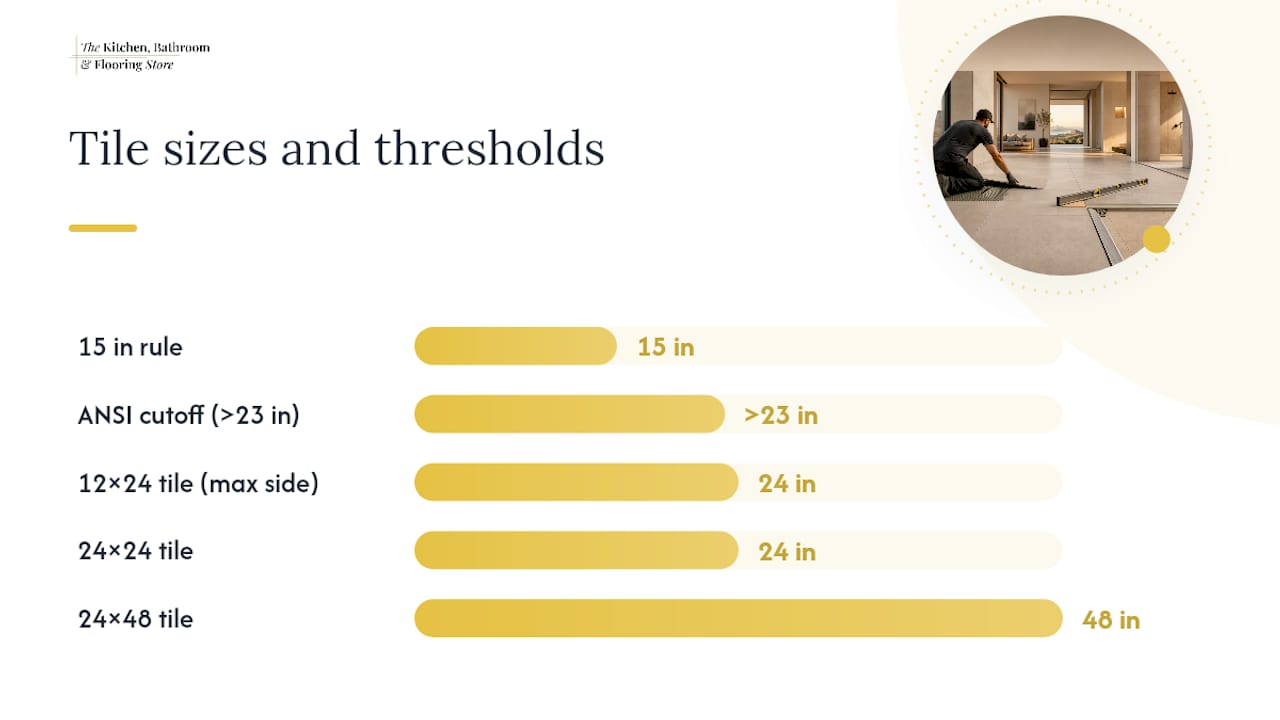
The size distinction matters because it triggers different rules. A 12x24 floor tile falls under the same flatness standard as a 24x48 slab, but a slab that qualifies as a gauged porcelain panel needs an entirely separate installation method. Knowing which category your tile falls into before you sign a contract saves you from surprise change orders once the crew shows up.
Fewer grout lines change the entire feel of a room. Large-format tile reduces the number of joints across a floor or wall, creating a continuous surface that reads as bigger and cleaner, especially in open-plan layouts where sightlines run long. That continuity is exactly why large-format porcelain has become the default choice for marble-look and concrete-look finishes. Fewer seams mean the veining or texture pattern flows uninterrupted instead of chopping into a grid.
Maintenance improves for a practical reason: grout is where dirt, grease, and mildew collect, and less grout means less to scrub. Porcelain large-format tile also resists stains and moisture well enough for showers, kitchen floors, and high-traffic hallways when the installation is done correctly.
Key benefits homeowners notice right away:
Pro Tip: Ask your installer for a leftover sample piece before the job starts. Holding an actual 24x48 slab in your hands makes the size, weight, and grout-line reduction click in a way a showroom display never quite does.
Gauged porcelain panels also appeal to homeowners chasing a sustainability angle: fewer, larger pieces can mean less packaging waste and fewer truck trips per square foot covered, though the handling requirements that come with that size are their own trade-off.
The single biggest disadvantage is substrate sensitivity. A long tile spans more of your subfloor or wall, so any dip, hump, or unevenness that a 4x4 tile would hide becomes visible as lippage, a raised edge where one tile sits higher than its neighbor. ANSI A108.02 and TCNA guidance require substrate flatness within tight tolerances for tiles with one side longer than 15 inches, and substrates that don’t meet those tolerances are the leading cause of cracked or failed large-format installations.
Labor costs climb accordingly. Large-format tile takes more people to lift and set safely, often requires suction cups or mechanical lifting aids for the biggest panels, and demands a slower, more deliberate pace than a standard 12x12 job. That translates into more labor hours and, frequently, a higher per-square-foot installation price than smaller tile carries, typically significantly more.
Other trade-offs worth budgeting for:
Before you approve any large-format tile estimate, put these four checks in writing.
Confirm substrate flatness. The ANSI A108.02 standard sets a tolerance of no more than 1/8 inch of variation across 10 feet, and no more than 1/16 inch across 24 inches, for any tile with a side longer than 15 inches. Ask your contractor to measure and document this before tile goes down, not after.
Require a minimum mortar coverage percentage. NTCA installation guidance sets targets around 80% coverage for interior dry areas and 95% for wet or exterior installations, with full, uninterrupted support at every edge and corner. Ask for a mortar class rated for large-format work, such as ANSI A118.15 or A118.4, and confirm the installer plans to back-butter tiles and use a properly sized notch trowel to hit that coverage number.
Ask about uncoupling membranes and leveling systems. Products like Schluter’s DITRA and DITRA-XL manage differential movement between the substrate and the tile, which helps prevent cracking over time. Leveling clips and spacers align adjacent tile edges, but they are not a substitute for a flat substrate.
Insist on a mockup and installer references. Setting a few tiles in place before committing to the full room lets you approve grout color, joint width, and acceptable lippage tolerance in advance.
Substrate flatness is not a nice-to-have detail buried in a spec sheet. It’s the single factor that determines whether a large tile lays flat or telegraphs every dip in the floor beneath it.
For gauged porcelain panels specifically, ANSI A108.19 and A108.20 cover a distinct set of embedding procedures, and installers typically need specialized training, a larger crew, and mechanical handling tools that a standard tile crew may not own.
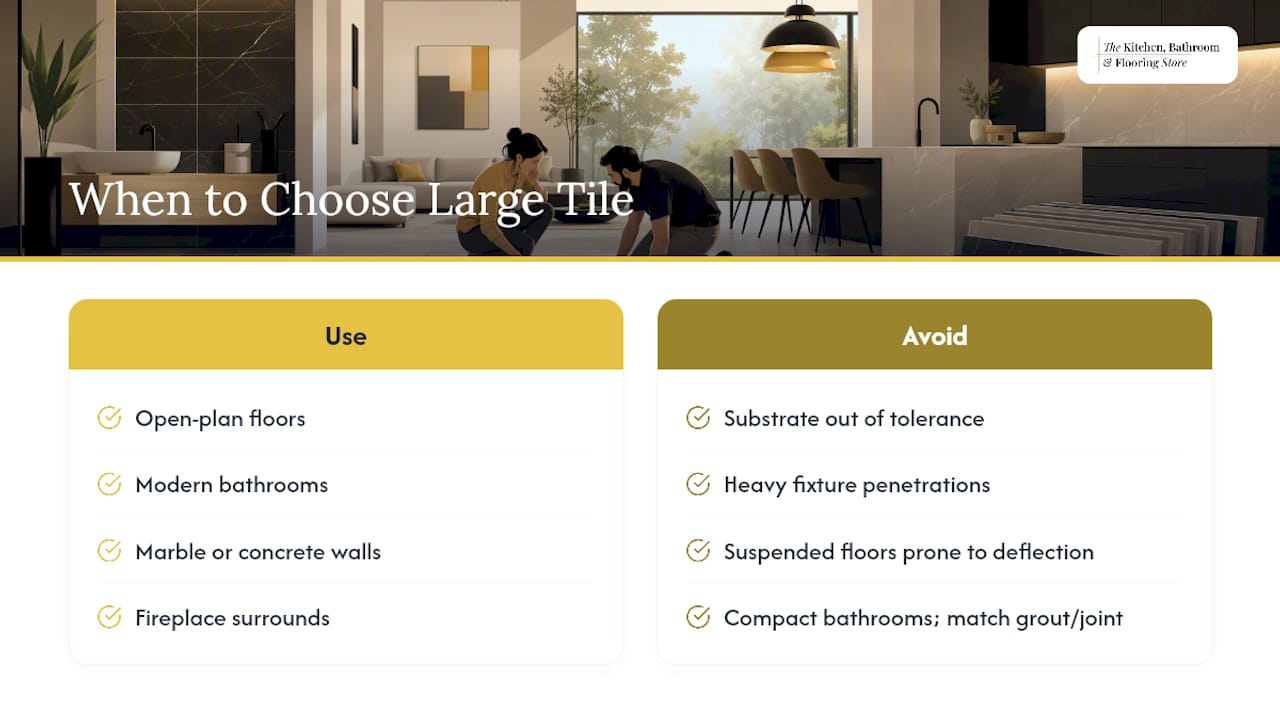
Large-format tile earns its reputation in open-plan floors, modern bathrooms, marble-look or concrete-look accent walls, and fireplace surrounds where a continuous, monolithic surface is the whole point of the design. It also works well on kitchen backsplashes where fewer seams keep grease and grime from collecting in grout lines.
Smaller tile stays the smarter choice when your substrate can’t be brought within tolerance affordably, when a room has heavy fixture penetrations or plumbing that breaks up the surface anyway, or on suspended floors prone to deflection. For a compact bathroom, matching grout color closely to the tile and choosing a realistic joint width rather than an ultra-thin one both help minimize the visual impact of minor lippage while still keeping that enlarged, open feel a small bathroom needs.
We treat substrate prep as its own line item, not an afterthought. The process typically includes design consultation, a site survey to measure floor and wall flatness, substrate correction where needed, a mockup for approval, and professional installation backed by a warranty. Before you hire anyone for a large-format job, ask to see a mockup and ask directly how many similar installations that specific crew has completed.
— Anna
Large-format tile is best handled as part of a complete remodel, rather than a standalone project you have to manage yourself. A comprehensive remodeling service ideally offers design assistance, product selection, substrate prep, and installation all under one roof, with warranty and financing options, to avoid the need to coordinate multiple separate contractors.
If a bathroom remodel is on your list, our bathroom tile installation team handles substrate leveling and mockups as a standard part of the Bathroom Remodeling Package. Request a site survey and we’ll measure your existing floor or wall against ANSI flatness tolerances before you commit to a single tile.
The main downsides are substrate flatness sensitivity, a higher risk of lippage and cracking, and more demanding installation that raises labor costs. ANSI A108.02 tolerances require the subfloor to be flat within 1/8 inch over 10 feet, and correcting an uneven substrate adds cost most homeowners don’t budget for upfront.
Yes, for most remodels, provided the substrate is properly prepped and the installer has documented experience with these sizes. The design payoff, fewer grout lines and a more continuous, modern look, holds up well over time when minimum mortar coverage targets are actually met during installation.
No. 12x24 remains one of the most common residential large-format sizes and is still widely specified for floors, showers, and backsplashes. It qualifies under the industry’s large-format size range, and its moderate size makes it easier to handle and install correctly than 24x48 slabs or gauged panels.
Yes, in most cases. Fewer grout lines make a small bathroom feel larger and less visually broken up, especially when the grout color closely matches the tile. The trade-off is that a small bathroom often has more plumbing penetrations, so expect more cuts and slightly more waste than you’d see on an open floor.