
A remodel warranty typically covers three layers of protection: the contractor’s workmanship for a limited period, manufacturer warranties on the products installed, and statutory or structural coverage for major defects that can surface years later. Understanding which layer applies to a specific problem, and who you call to fix it, is what separates a smooth claim from a frustrating dispute.
Here is the baseline you should know before reading further:
Before you sign anything, confirm three things in the contract: the exact start date of coverage (typically substantial completion or final acceptance), which manufacturer warranties are passed through to you in writing, and whether the contractor will support your claim if a product defect surfaces after installation.
A remodel warranty covers three distinct layers: contractor workmanship, manufacturer materials, and statutory structural protection, each with its own duration, responsible party, and claim process.
| Point | Details |
|---|---|
| Three-layer warranty model | Workmanship (contractor), manufacturer/material, and structural/statutory coverage each apply to different defects with typical durations. |
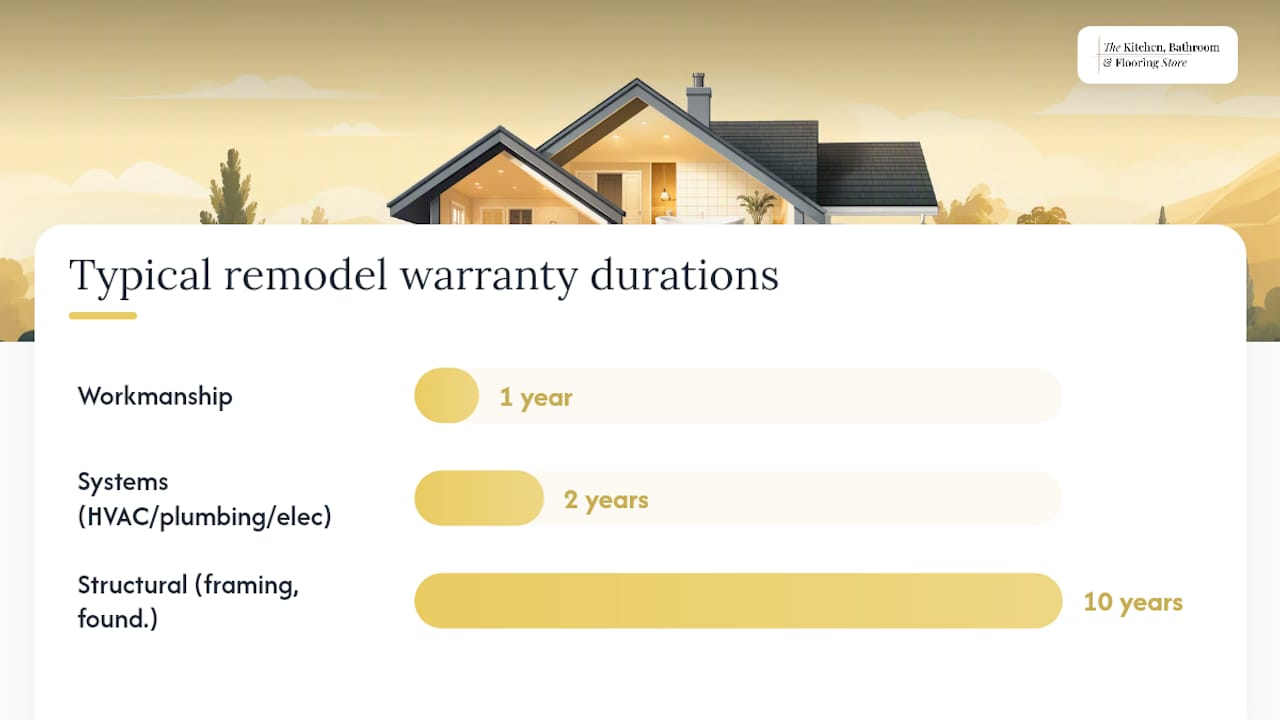
| Typical durations | One year for general remodeling workmanship, two years for systems such as HVAC, plumbing, and electrical, and ten years for major structural defects are common industry benchmarks. Specialty trades, like roofing, sometimes offer two years for workmanship. |
| Top exclusions to avoid | Normal wear and tear, unauthorized repairs, deferred maintenance, and modifications by other contractors frequently void coverage. |
| Claim checklist | Document in photos, notify in writing, preserve evidence, allow inspection, and keep permit and inspection records in a single project folder. |
| The Kitchen, Bathroom & Flooring Store | Provides written workmanship warranties, assists with manufacturer registrations, and delivers a closeout packet so your documentation is ready from day one. |
Not every warranty in a remodel comes from the same source, and that distinction matters the moment something goes wrong. Contractor workmanship warranties cover defects resulting from poor installation or failure to follow plans, while manufacturer warranties are express guarantees from the product maker about the quality or durability of the materials themselves. These are separate documents with separate obligations.
An express warranty is a written promise from your contractor that the labor was performed correctly. Industry standard workmanship warranties for remodeling are generally about a year, with specialty trades sometimes offering longer periods. Roofing, for example, often carries a two-year workmanship period. The contractor writes this warranty, so its scope, duration, and claim process are negotiable before you sign.
When your contractor installs a product, the manufacturer’s warranty travels with that product. Cabinets, tile, hardwood flooring, plumbing fixtures, and appliances each carry their own terms. The contractor’s warranty does not automatically extend the manufacturer’s labor obligations, so if a cabinet door fails in year three under a five-year product warranty, the manufacturer may cover the part but not the labor to reinstall it. That gap is worth addressing in your contract.
A pass-through means the contractor formally assigns the manufacturer’s warranty to you at project close. A clear, enforceable remodeling warranty should make manufacturer pass-throughs and duration explicit. Without a written pass-through, you may have to pursue the manufacturer directly with no contractor support.
Implied warranties such as the warranty of workmanlike performance and the warranty of habitability often exist automatically under state law, providing baseline protection even without a written warranty. These are not negotiated; they arise by operation of law. Some states also codify minimum warranty periods for residential construction, which can exceed what a contractor offers in writing. Check your state’s statutes, because these floors cannot be waived in most residential contracts.
Pro Tip: Ask your contractor to list every manufacturer warranty by product at contract signing, confirm which ones require registration, and register each product within the window the manufacturer specifies. Missing a registration deadline can void coverage entirely.
Knowing the warranty types is useful. Knowing which one applies to the crack in your tile or the dripping faucet is what actually gets it fixed.
Workmanship warranties cover installation defects, while manufacturer warranties cover product defects. In practice, the line between the two can blur, which is why documentation at project close matters so much.
| Issue | Likely Warrantor | Typical Remedy |
|---|---|---|
| Tile delaminating from floor within one year | Contractor (workmanship) | Contractor re-sets tile at no charge |
| Cracked tile from a manufacturing defect | Manufacturer | Replacement tile; labor may be out-of-pocket |
| Cabinet door hinge failing under product warranty | Manufacturer (parts) | Replacement part; contractor may charge labor |
| Shower pan leaking due to improper waterproofing | Contractor (workmanship) | Contractor repairs waterproofing |
| Hardwood flooring cupping from moisture intrusion | Depends on cause | Contractor if installation error; manufacturer if product defect |
The hardwood cupping example shows why cause matters. If the installer failed to acclimate the flooring before installation, that is a workmanship defect. If the product itself was defective, that falls to the manufacturer. A flooring warranty claim often requires a third-party inspection to determine which party bears responsibility, and having your permit records and installation photos ready speeds that process considerably.
When a manufacturer covers the replacement part but not the labor, you may face out-of-pocket costs for reinstallation after the contractor’s workmanship period expires. That is the gap a pass-through arrangement, combined with explicit labor coverage language in your contract, is designed to close.
Most warranty disputes do not start with a defect. They start with a homeowner doing something that gives the contractor or manufacturer a reason to deny the claim. Knowing the common exclusions protects your coverage.
Typical exclusions across workmanship and manufacturer warranties:
Unauthorized repairs are a particular risk. If a fixture leaks and you call a different plumber to fix it before notifying your original contractor, you may have voided the workmanship warranty on that system entirely. The contractor’s warranty language almost always requires written notice and an opportunity to inspect before any remediation work begins.
Watch out for “lifetime” warranty claims. In product marketing, “lifetime” typically means the expected useful life of the product as defined by the manufacturer, not the homeowner’s actual lifetime. A “lifetime” finish warranty on a faucet may cover only 10–15 years under the manufacturer’s own definition Always ask the manufacturer to define “lifetime” in writing before relying on that term for long-term planning.
Transferability is another area where homeowners are often surprised. Some workmanship warranties do not transfer to a new owner if you sell the home. Flooring warranty transfer mechanics vary by product and installer, so if you plan to sell within the warranty period, confirm transferability in writing before closing the project.
Duration is where homeowner expectations and contract reality diverge most often. Builder and construction warranties are commonly segmented into time bands for workmanship, mechanical systems, and structural defect coverage in many industry frameworks. These are industry norms, not universal legal requirements, but they give you a reasonable baseline for negotiation.
Beyond warranty duration, two legal timelines affect your ability to pursue a claim.
The statute of limitations is the window you have to file a lawsuit after you discover a defect. This clock typically starts when you knew or reasonably should have known about the problem, which matters for latent defects that take years to surface.
The statute of repose is an absolute cutoff tied to the project’s completion date, regardless of when you discover the defect. Many states set this at 6–10 years for construction. Once it expires, you generally cannot bring a construction defect claim even if the defect was hidden.
The start date in your contract is not a minor detail. Whether coverage begins at substantial completion, final acceptance, or punch-list sign-off can shift your protection window by weeks or months. Many contractor warranty templates recommend clear start triggers and attaching closeout documentation to the warranty. Get that date in writing, and keep a copy of the signed closeout packet.
Pro Tip: For structural issues with long latency, document your project’s completion date precisely and note your state’s statute of repose. Some states require you to take preservation steps, such as sending a formal written notice, before the repose period expires.
A well-documented claim moves faster and settles better than one assembled after the fact. Here is a practical sequence to follow.
Typical remedies available:
Note that many contractor warranties limit consequential damages. If a leaking pipe causes water damage to your flooring, the warranty may cover fixing the pipe but not replacing the floor. That limitation is worth negotiating out before you sign.
Escalation paths when a claim stalls:
Evidence that strengthens any claim:
Permit and inspection records serve as critical benchmarks for warranty claims. Work completed under valid permits with inspections provides documentation of code compliance that can support or refute a workmanship dispute.
The contract is where your warranty protection is either built or lost. Before you sign, confirm these items are present.
A sample clause for the workmanship start date might read: “The workmanship warranty period of [X] years begins on the date of substantial completion, defined as the date the homeowner signs the project acceptance form.” For a manufacturer pass-through: “Contractor assigns to homeowner all manufacturer warranties for products installed under this contract and will provide claim-support documentation upon request.”
Pro Tip: During your estimate appointment, ask the contractor to walk you through the warranty section of their standard contract. A contractor who cannot explain their own warranty terms clearly is a contractor worth reconsidering.
Most warranty problems are preventable. The homeowners who get the fastest resolutions are the ones who treated documentation as part of the project from day one.
Pro Tip: Schedule a final walkthrough inspection before signing project acceptance. Note every incomplete item in writing. Defects you accept at closeout are harder to claim as warranty issues later.
Common homeowner mistakes that cost coverage:
How documentation shifts disputed claims:
Consider a scenario where grout cracks appear six months after a tile installation. Without permit records, the contractor can argue the substrate was pre-existing. With a permit and a passed inspection confirming the substrate was prepared to code, the burden shifts back to the installation. Promptly registering manufacturer warranties and keeping installation documentation materially improves your leverage when seeking remedies.
For flooring specifically, understanding the difference between manufacturer and installer responsibilities before a claim arises helps you contact the right party immediately rather than losing weeks in back-and-forth.
Keep a single project folder, physical or digital, with: the signed warranty document, all manufacturer warranty cards and registration confirmations, permit records, inspection sign-offs, product receipts, serial numbers, and before-and-after photos. That folder is your claim kit.
Most homeowners focus on the design and the price. Warranty terms get a quick scan at signing, if they get read at all. That is the wrong order of priorities.
A warranty is only as useful as the documentation behind it. A contractor who pulls permits, passes inspections, and hands you a closeout packet with serial numbers and registration confirmations is giving you something more valuable than a longer warranty period from a contractor who skips those steps. The paper trail is the warranty.
Single-source responsibility matters here more than most homeowners realize. When one contractor manages the entire project, from design through installation, there is no finger-pointing between trades when something goes wrong. The full-service remodeling model simplifies claims because there is one party accountable for the whole scope.
The other thing worth saying plainly: implied warranties exist, but relying on them is slower and more expensive than relying on a clear written warranty. State law gives you a floor, not a ceiling. Negotiate the ceiling before you sign.
When you hire The Kitchen, Bathroom & Flooring Store for a kitchen, bathroom, or flooring project, you get written workmanship coverage on every installation, handled by a single team from design through final walkthrough. We assist with manufacturer warranty registrations at project close and provide a closeout packet with serial numbers, permit records, and product documentation so your claim kit is ready before you ever need it.

Because we manage the entire project in-house, there is no contractor-versus-manufacturer runaround when a question comes up. One call reaches the team that did the work. That single-source accountability is built into how we operate, not added as a feature.
If you are planning a bathroom or flooring project and want to review warranty language before committing, our bathroom remodeling packages and flooring services pages are a good starting point. Request a free in-home estimate and ask us to walk you through the warranty section of the contract. We will.
These resources give you authoritative, independent guidance when researching warranty rights or escalating a dispute.