
Countertop edge profiles determine how a countertop looks, performs, and lives with your family every single day. The edge you choose changes the perceived thickness of your slab, decides whether a toddler can run through your kitchen safely, controls how much time you spend scrubbing crumbs out of grooves, and shifts your total project cost by hundreds of dollars. Here’s the quick map: eased edges suit almost any kitchen and budget, bullnose profiles work best for households with kids or heavy daily use, and mitered or waterfall edges make a design statement if you have the budget and the right fabricator.
Pro Tip: Before you fall in love with a profile photo online, check with your fabricator about whether your chosen material and edge combination has actually been done successfully before.
The right countertop edge profile balances aesthetics, safety, cleanability, durability, and cost, and no single profile wins on every factor at once.
| Point | Details |
|---|---|
| Match edge to household | Choose eased or bullnose for kids and heavy daily use; save ornate edges for accent areas. |
| Confirm material compatibility | Marble risks breakout on intricate cuts; porcelain needs specialized diamond tooling. |
| Budget for complexity | Basic profiles cost less per linear foot; mitered and waterfall edges add material and labor cost. |
| Ask fabricators direct questions | Confirm prior experience with your exact material and profile combination before committing. |
| Work with one provider | The Kitchen, Bathroom & Flooring Store handles design, fabrication oversight, and installation together to reduce profile-selection mistakes. |
The edge is the part of the countertop your hand touches, your eye lands on, and your kids bump into. It carries more functional weight than most homeowners expect during the design phase.
Start with visual weight. A thick-looking mitered or waterfall edge reads as substantial and modern, while a thin eased edge feels lighter and more traditional, even on the exact same slab. That single design decision changes how “expensive” a kitchen looks without changing the material at all.
Safety is not a minor footnote. Sharp 90-degree edges are a known impact risk in busy kitchens, which is why NKBA and FDA Food Code guidance point toward smoother, more forgiving profiles for household and commercial use alike. If you have small children or aging parents in the home, this consideration should carry real weight in your decision.
Resale value follows the same logic as kitchen trends generally: buyers gravitate toward clean, adaptable choices they can picture living with, not edges that reflect one very specific taste.
Every edge profile trades something for something else. Some buy you safety at the cost of a bit of visual flair; others buy drama at the cost of budget and fabrication risk. Here’s how the most common options stack up.
Eased edge. A slightly softened 90-degree corner that reads as clean and modern. It’s the easiest profile to clean, the least expensive to fabricate, and works with virtually any kitchen style. Eased and demi-bullnose profiles are currently the most commonly specified edges in contemporary and transitional kitchens for exactly these reasons.
Beveled edge. A cut angle, usually 45 degrees, that catches light along the slab’s rim. It looks sharp and architectural but has moderate chip risk at the angled point compared to a fully rounded edge.
Half or full bullnose. A fully rounded edge with no hard corner anywhere. It’s the safest option on this list and carries low chip risk, though a full bullnose can let spills roll off the edge rather than pooling for easy wipe-up.
Pencil edge. A subtle, thin rounding that softens the corner without adding visual bulk. It’s a classic detail that reads as refined without shouting for attention.
Ogee and Dupont edges. Ornate, S-curved or stepped profiles that add serious visual detail. They also demand real fabrication skill and higher maintenance because the grooves collect grime.
Mitered and waterfall edges. These make the slab appear far thicker than it is, or wrap it dramatically down the side of a cabinet or island. They’re dramatic and increasingly popular in high-end modern kitchens, but they require precise miter joins and cost more.
Cove and chiseled edges. Cove adds a concave groove for a soft, traditional look; chiseled leaves a rough, rustic texture. Both need more frequent, more deliberate cleaning than smoother options.
Choosing an edge profile isn’t about picking the prettiest photo. It’s about matching geometry to how your household actually lives, cooks, and cleans.
Pro Tip: Bring a tape measure and a photo of your kitchen layout to your fabricator meeting. Knowing your linear footage upfront turns a vague quote into a real number fast.
Edge profiles are cut using CNC routing for consistent, repeatable shapes, or hand tooling for custom and rustic finishes. Waterfall and mitered edges require lamination or precise miter joints, where two pieces of stone or engineered surface are cut at matching angles and bonded to look like one continuous slab. Get that miter even slightly wrong and the seam shows, which makes rework expensive and slow.
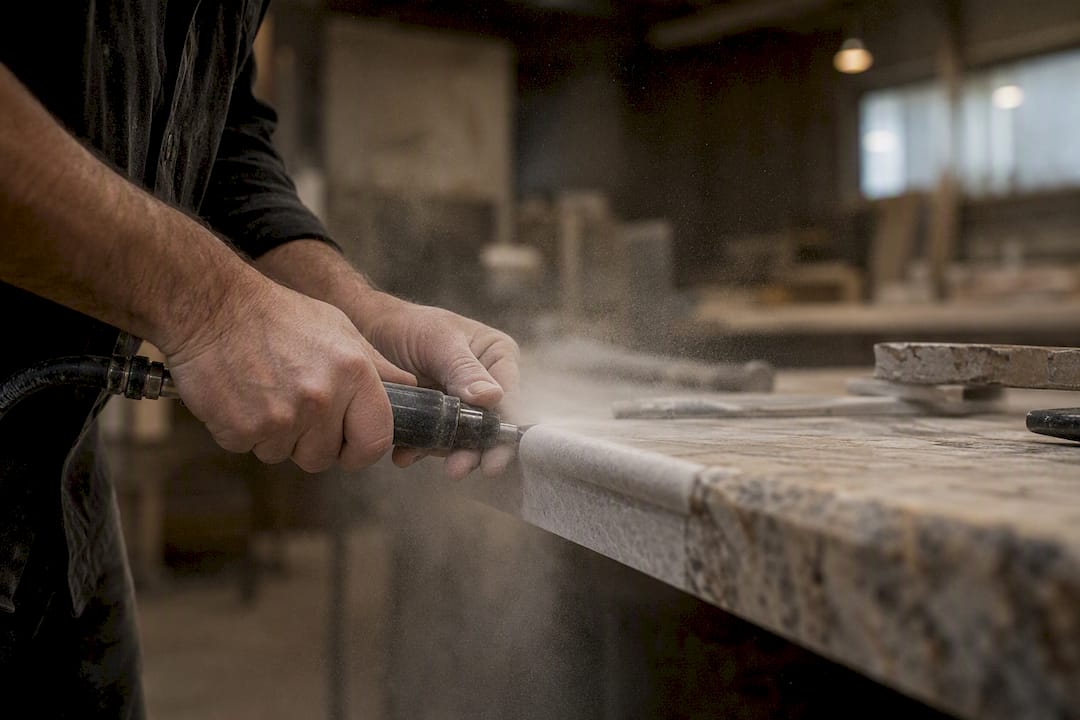
Material dictates what’s even possible. Marble and other softer natural stones carry a higher risk of breakout or fracture along intricate edge cuts, while porcelain slabs need specialized diamond tooling to shape anything beyond a simple eased or beveled line. Granite and quartz tend to be more forgiving across a wider range of profiles.
Cost climbs with complexity. Basic profiles like eased or beveled edges typically add less to the base fabrication cost per linear foot, while ornate or mitered and waterfall builds can add substantially more once you factor in extra material, labor time, and skilled handling. Some fabricators will simply decline certain profile and material combinations outright if they don’t have the tooling or track record to execute them safely. If you’re weighing edge upgrades against a broader project budget, it helps to map that spending against a full budget kitchen remodel checklist before you commit.
Cleaning routines should match the edge you picked, not fight against it.
Choosing an edge profile in isolation is risky, so it’s important to consider how your choice complements your cabinetry and interior style as explained in How to Choose the Right Interior Door Style. Choosing it alongside your cabinetry, your material, and your fabricator all at once is how you avoid the mismatch surprises this article has walked through. That’s the advantage of working with one team from start to finish.
This single-contractor approach reduces the odds of a costly mismatch between what you picked and what your material and fabricator can actually deliver.
Edge choice has an environmental footprint that most homeowners never think to ask about. Every cut removes material, and more complex profiles waste more of it. An eased or beveled edge shaves off a thin sliver of stone or engineered surface. A deep ogee or chiseled edge removes considerably more material per linear foot, and that offcut usually can’t be reused for anything structural.
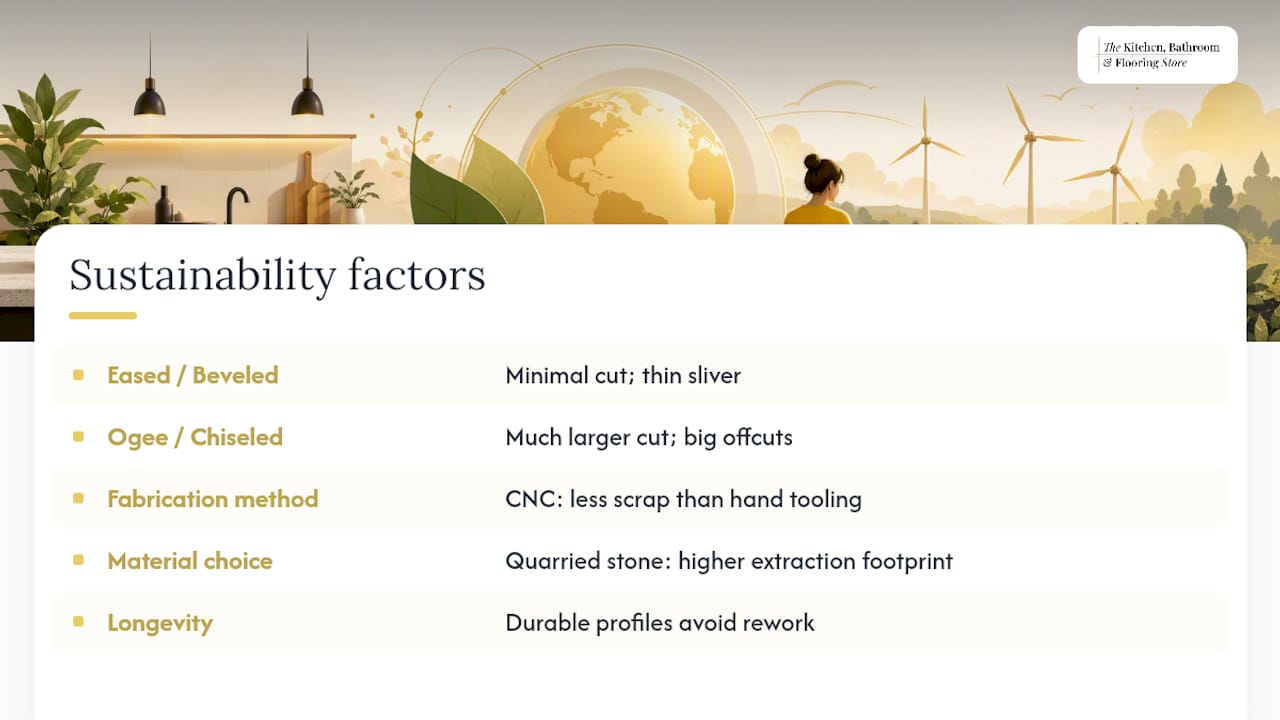
Fabrication method matters too. CNC routing is generally more precise and produces less scrap than hand tooling, since the machine follows an exact path rather than requiring trial cuts. If sustainability is a priority for your project, ask your fabricator whether offcuts are recycled, repurposed into smaller pieces like vanity tops or cutting boards, or simply discarded.
Material choice compounds the impact. Quarried natural stone carries a heavier extraction footprint than engineered quartz, which blends stone particles with resin and can incorporate recycled content depending on the manufacturer. A simpler edge profile on a more sustainably produced material often does more for your environmental footprint than an ornate edge on a rare imported stone.
Longevity plays a role as well. A durable, chip-resistant profile that lasts decades without needing replacement is, in a practical sense, the more sustainable choice over one that requires repair or a full slab swap within a few years. Choosing well the first time avoids the material and energy cost of doing the project twice.
The biggest mistake is choosing a profile from a photo without checking whether it works on your specific material. An ogee edge that looks stunning on granite can be a structural gamble on marble, where the stone is more prone to breakout along intricate cuts.
The second mistake is running an ornate profile across an entire kitchen perimeter instead of reserving it for a smaller feature. Designers commonly limit ornate or double-ogee profiles to bathrooms or small bar areas precisely to avoid the cost and upkeep burden of maintaining that detail over dozens of linear feet.
A third common error: prioritizing the “wow” factor of a waterfall or mitered edge without asking whether your fabricator has actually executed one successfully before. A miscut miter join is expensive to fix and sometimes means starting over with new material.
Homeowners also frequently underestimate maintenance. A stunning chiseled or cove edge photographed in a magazine rarely shows the extra scrubbing time it demands week after week. And finally, some skip the safety conversation entirely, choosing sharp geometric edges purely for looks in a kitchen used daily by young children or older family members, when a softer profile would have delivered nearly the same look with far less risk.
Most guidance out there treats edge profiles as a purely cosmetic decision, something you pick last, almost as an afterthought after choosing material and color. That’s backwards. The edge is the part of the countertop you touch and interact with the most, and treating it as decorative garnish is how homeowners end up with a beautiful photo and a daily annoyance.
The conventional wisdom also oversells ornate profiles as the mark of a premium kitchen. In practice, simpler profiles align with current design trends and hold up better over time, which means the “safe” choice is often also the smarter long-term one, not a compromise.
If I had one piece of advice for a reader standing in a showroom right now, it would be this: decide your safety and cleaning priorities before you fall for a profile’s looks. Ask your fabricator what they’ve actually built before on your chosen material, not what’s technically possible in theory. That single question filters out more bad outcomes than any style guide ever will.
— Anna
Photos and product pages only tell you so much about how an edge profile actually looks and feels. The Kitchen, Bathroom & Flooring Store gives you something a catalog can’t: a showroom where you touch real slabs with real edge cuts, ask your fabrication questions face to face, and walk out with a plan instead of a guess.
Bring your kitchen measurements, a few photos of your current space, and a rough sense of your style priorities, whether that’s family-friendly safety or a dramatic waterfall island. Our team will walk you through which profiles fit your material, your budget, and your household, then handle design, fabrication, and installation under one roof. Explore our kitchen countertop options or check out current bathroom remodeling packages if your project spans more than one room. Financing options are available, so reach out today to schedule your consultation.