
A waterfall edge delivers the single biggest visual upgrade you can make to a kitchen island, but it comes with real tradeoffs in cost, seating room, and long-term care. It suits a visible island with a decent budget and an experienced fabricator. If your kitchen is tight on space or your budget is thin, a one-end waterfall or a matching end panel gets you most of the look for less.
TL;DR:
- Waterfall edges significantly enhance a kitchen’s visual impact but require precise fabrication and can add $1,000 to $2,000 in costs per panel.
- Quartz and porcelain are the most durable materials for waterfall legs, offering predictable matching and high resistance to stains and scratches.
- The vertical corner of a waterfall panel is vulnerable to chipping, staining, and wear, especially in busy households or with natural stones like marble.
- Proper planning, including sightline testing and outlet placement, is crucial to ensure the waterfall feature aligns with kitchen layout and usability.
- Simpler edge profiles like bullnose or mitered edges provide a more cost-effective and lower-maintenance alternative, with a timeless appeal suited to most kitchens.
A waterfall edge is a countertop slab that keeps going past the corner, running straight down the side of an island or peninsula to the floor or near it, instead of stopping at a standard edge. The unbroken vein or pattern from top to side is the whole point. You’ll see it most on kitchen islands, peninsulas, and increasingly on bathroom vanities. Fabricators create the look with a mitered seam at the corner and book-matched slab pieces, work that applies to natural stone, quartz, porcelain, and even manufactured surfaces alike.
The appeal comes down to how a waterfall edge reframes an entire room. Instead of a countertop that simply ends, the material becomes a piece of furniture, drawing the eye down and giving the island a sense of weight and intention. Designers often use it as the visual anchor of an open-concept kitchen, since it reads as sculptural rather than purely functional.
There’s a practical upside too. An exposed stone or quartz face on the side of an island holds up better against scuffs, knee marks, and water than a wood or laminate panel, which tends to show wear faster in high-traffic areas.
Pro Tip: If you love the look but aren’t sure your kitchen can support it, ask your fabricator to mock up a one-end waterfall first. You get the same continuity on the side people actually see from the main walkway, at a fraction of the material cost.
The tradeoffs are real, and they show up in three places: your budget, your cleaning routine, and your kitchen’s usable space.
Cost is the obvious one. A waterfall panel needs an extra slab section and precise mitered joinery, which adds real labor and material beyond what a standard edge requires. Chipping is the second issue. Corners on a waterfall leg take a beating from foot traffic, dropped pans, and vacuum cleaners, and natural stones like marble are also prone to etching from acidic spills at the base. Engineered quartz resists both better, but no surface is immune.
Homeowners who’ve lived with a waterfall for a few years report a consistent set of annoyances, according to design writers at The Kitchn:
Adding up to $1,000 to $2,000 in extra fabrication fees is typical for a single waterfall leg, according to Bob Vila, on top of the additional slab material itself.
Not every countertop material handles a 90-degree bend and years of foot traffic the same way. Some are far more forgiving than others.
Quartz and porcelain (also called sintered stone) are the safest bets for most kitchens. Their patterns repeat consistently across a slab, which makes book-matching the corner seam far more predictable, and both resist stains and scratches better than most natural stone for high-contact vertical surfaces. Marble is gorgeous on a waterfall leg, but its veining varies slab to slab, so matching the pattern across the miter takes a skilled eye, and the surface etches if wine or lemon juice sits on it. Granite is tougher against etching but has the same veining-match challenge. Concrete and wood are the DIY-friendly options, though both need different structural support and more frequent resealing or refinishing than stone.
Pro Tip: Ask for a slightly eased or small-radius edge on the vertical corner rather than a sharp 90 degree angle. It looks nearly identical but chips far less over time.
Budgeting for a waterfall edge means budgeting for more than just “a bigger countertop.” Three cost drivers show up again and again.
First, the fabrication fee itself. Mitering a clean corner seam, especially with CNC-cut precision, typically adds a significant surcharge on top of your base countertop price, according to Bob Vila. Second, slab waste. Book-matching the vertical panel to the horizontal surface means the fabricator has to cut around the pattern, which uses more of the slab and sometimes forces you to buy a second slab entirely. Third, hidden site work: leveling an uneven subfloor where the panel meets the ground, reinforcing the corner so it doesn’t stress-crack, and rerouting outlets that used to live on the now-covered side of the island.
Before you sign off with any fabricator, ask these questions:
A fabricator who can’t produce seam photos on request is a red flag worth taking seriously.
Run through this checklist before you commit to fabrication:
Pro Tip: If the sightline test fails, don’t force it. A one-end waterfall paired with a strong edge profile on the visible side often looks just as intentional for less money and less risk.
Getting a waterfall edge right depends on coordination between design, slab selection, and installation, which is exactly why we handle all three under one roof. Our team walks you through kitchen countertop options in person, so you can see slab veining and book-matching before anything gets cut. We manage the project from design consultation through final install, which means one point of contact instead of juggling a designer, a fabricator, and a separate installer.
A waterfall edge ages differently than a standard countertop, mostly because of where the stress lands. The vertical corner absorbs impact from foot traffic, dropped tools, and the occasional kicked bar stool, so it wears faster than the horizontal surface above it.
Sealing matters more here than on a flat countertop. Natural stone, especially marble and granite, needs resealing on a regular schedule, and the vertical face is more exposed to splashes near the floor, from mopping, spills, or pet water bowls. Skipping resealing accelerates staining and etching right at the base, which is also the hardest spot to fix without redoing the whole panel.
Chip repair on a waterfall corner is trickier than a flat-surface repair because the corner takes the visual hit from multiple angles. A skilled fabricator can fill and polish small chips on quartz and porcelain fairly seamlessly. Marble repairs are harder to disguise since the fill has to match veining that runs in a specific direction. If a corner takes a serious hit, sometimes the only real fix is replacing that panel section, which means matching the original slab years later, not always possible if the quarry lot has changed.
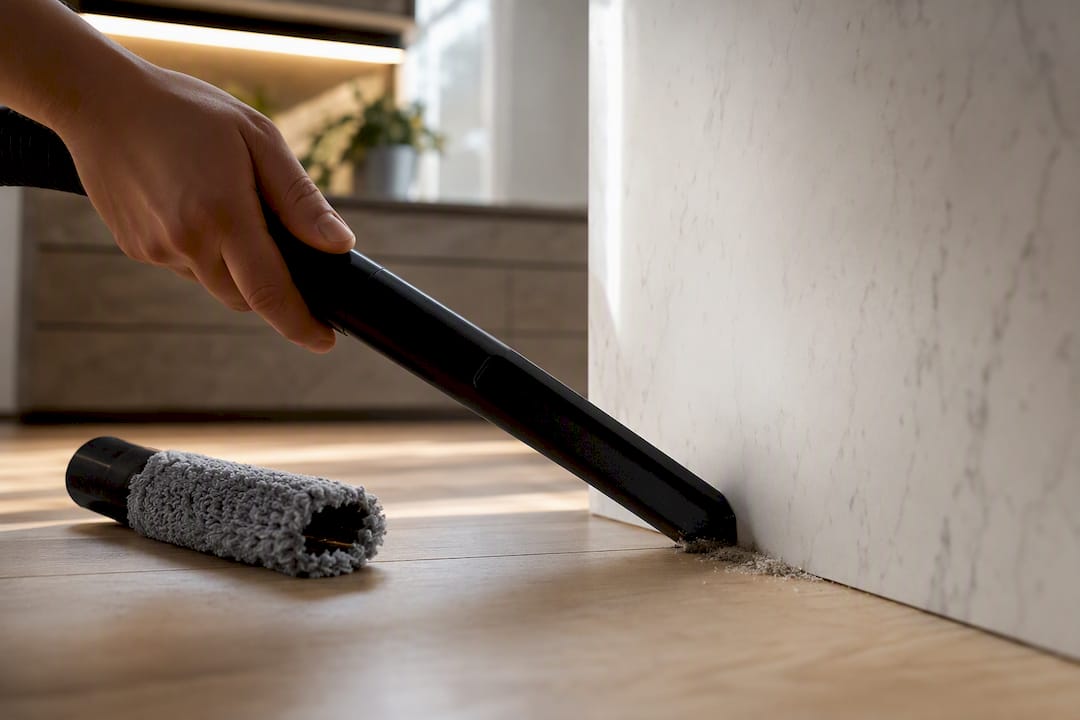
Day-to-day cleaning is where most owners notice the tradeoff. Crumbs and dust collect at the floor line where the panel meets the ground, and that gap is harder to reach with a standard vacuum attachment. A microfiber mop head or a narrow crevice tool becomes part of the regular routine for most waterfall households. None of this makes a waterfall edge high-maintenance in the way a wood floor is high-maintenance. It just shifts where the maintenance attention goes: from the top of the counter to the base of the panel.
Set against other edge profiles, a waterfall edge trades convenience for visual drama, and that trade only makes sense for certain kitchens.
A standard eased or bullnose edge costs less to fabricate, has no exposed vertical panel to chip, and works in almost any kitchen layout regardless of how visible the island is. What it doesn’t do is create any kind of focal point. It’s countertop, full stop. A mitered edge (a thicker-looking front edge without the full vertical drop) gives some of the substantial, high-end look of a waterfall at a lower cost, since it only requires mitering the front lip rather than an entire side panel. It’s a solid middle ground for kitchens where the island’s side isn’t highly visible anyway.
Bevel and ogee edges lean decorative and traditional, popular in classic or transitional kitchens, but they don’t offer the sleek continuity a waterfall provides, and ornate profiles tend to trap crumbs in their grooves more than a flat waterfall panel does. A waterfall on one end only, rather than wrapping both sides of the island, is worth calling out as its own category. It captures the visual payoff on whichever side faces the room’s main sightline, while leaving the seating side open with full knee clearance, essentially splitting the difference between full waterfall and standard edge.
The honest comparison isn’t “waterfall versus everything else.” It’s whether your kitchen’s layout and your budget support the full-drama version, or whether a partial waterfall or upgraded standard edge gets you 80% of the impact at a fraction of the cost and risk.
A waterfall earns its cost on a large, clearly visible island where the budget covers a skilled fabricator, not a rushed one. For smaller kitchens or households with heavy daily traffic, a one-end waterfall or a durable matching panel usually delivers similar visual payoff with less risk. Whichever you choose, plan for the corner to need attention eventually. It’s the hardest-working spot on the whole counter.
— Anna
Get a single point of contact for your entire project instead of juggling separate professionals for design, slab sourcing, and fabrication. Design consultation, slab sourcing, and installation are coordinated to ensure decisions about seams, book-matching, and outlet placement are made before fabrication begins.
When you come in for a consultation, ask to see the slab layout drawing, request photos of a finished mitered seam from past work, and get an itemized breakdown of fabrication costs before you commit. That’s the same checklist we walked through above, and it’s exactly what our team will walk through with you. Start by browsing kitchen countertop options or explore a full kitchen remodeling package if you’re planning beyond just the counters.
For further reading on waterfall countertops, cost ranges, and material selection, see the coverage from Architectural Digest, Bob Vila, Better Homes & Gardens, and The Kitchn.
No. Waterfall edges remain a widely specified design feature, and design writers still recommend them for islands and peninsulas that serve as a kitchen’s visual focal point, though they work best in the right layout rather than every kitchen.
It’s worth it if your island is large, visible from the main sightline, and your budget covers the added fabrication cost of roughly $1,000 to $2,000. If your kitchen is small or budget is tight, a one-end waterfall or a strong standard edge profile often delivers a similar payoff for less.
They remain a popular high-end feature rather than a fading trend, particularly with quartz and porcelain surfaces that make book-matching more consistent and predictable across the mitered seam.
A standard eased or bullnose edge is the safest long-term choice because it works in nearly any kitchen style and carries no risk of the chipping or seam-visibility issues that come with a waterfall panel. For homeowners who want more visual impact without that risk, a mitered front edge is a durable middle ground.