
The best time to remodel a kitchen is when you can start planning about six months before you want to cook in it again. For most Jacksonville homeowners, that means deciding in fall, ordering cabinets before the holidays and having crews install in the cooler, quieter months of winter. Spring and early summer are the busiest stretch for remodelers. Hurricane season is the other thing to plan around. Your own calendar still matters most: a kitchen that no longer works is worth fixing sooner, whatever the month.
Below, we walk through how the seasons compare, what drives the real schedule (cabinet lead times, not the weather), and how to pick a start date that fits your household and budget.
Before you pick a month, ask whether this is the year. Real Simple’s guidance frames remodeling as a response to function, condition and lifestyle rather than an automatic age-based cycle. About 15 years is a rule of thumb for kitchens, not a deadline.
Signs that point to a full remodel:
Real Simple’s kitchen guide also notes that a kitchen that works but looks dated may only need paint, hardware, a backsplash, countertops or lighting. A full remodel is most justified when the kitchen does not support cooking, baking, storage or daily household needs. If you are not sure which camp you are in, a design consultation at our showroom will sort it out before you commit to anything.
Most national articles on this topic were written for places with real winters. Northeast Florida is different: indoor work continues year-round, and the calendar pressure comes from demand and storms, not snow. Here is how we see each season for a Duval, St. Johns or Clay County kitchen.
| Season | What works in your favor | What to watch |
|---|---|---|
| Winter (December to February) | Mild days for deliveries and open doors, typically calmer remodeler schedules after the fall rush | Holiday gaps in crew availability, supplier closures around the holidays |
| Spring (March to May) | Long daylight, dry weather, easy outdoor grilling while the kitchen is down | Peak booking season, so scheduling slots fill early |
| Summer (June to August) | Kids are out of school (a plus or a minus), good outdoor cooking weather | Heat and humidity, storm season starting, vacations that stall decisions |
| Fall (September to November) | Good time to design and order, so installation lands in winter | Tropical storm risk early in the season, holiday deadline pressure if you start too late |
National remodeler data shows a normal seasonal slowdown around the holidays, even when overall demand is healthy. In the NAHB/Westlake Royal index, remodelers reported fairly strong conditions in Q4 2025 with a reading of 64. For a homeowner, a slower period can mean easier scheduling and more attention from your project team.
The catch is the holidays themselves. Few families want a torn-out kitchen at Thanksgiving or Christmas. The trick is to start the demolition after New Year’s, with the cabinets already ordered and waiting.
Spring is popular for good reasons: longer days, dry weather and the chance to finish before summer entertaining. That popularity is exactly why it is the hardest time to get on a calendar. Many remodelers book out well ahead, so if spring is your goal, the planning has to happen the previous fall.
Summer works well for families who can use the grill, a patio and takeout for a few weeks. It is also when vacations and storm watches can interrupt decisions and deliveries.
Fall is where we see the smartest timing. The summer rush is over, and you have the time to settle on layout, cabinets, countertops and finishes. Ordering in October or November lets production happen while you wait, so installation can begin in the new year.
Homeowners often ask when the work should start. The better question is when the cabinets should be ordered.
USA Today reports that a full kitchen remodel typically takes three to six months from start to finish, with larger projects running eight months or longer. Planning and design average one to three months, and custom cabinet production and delivery takes eight to 20 or more weeks.
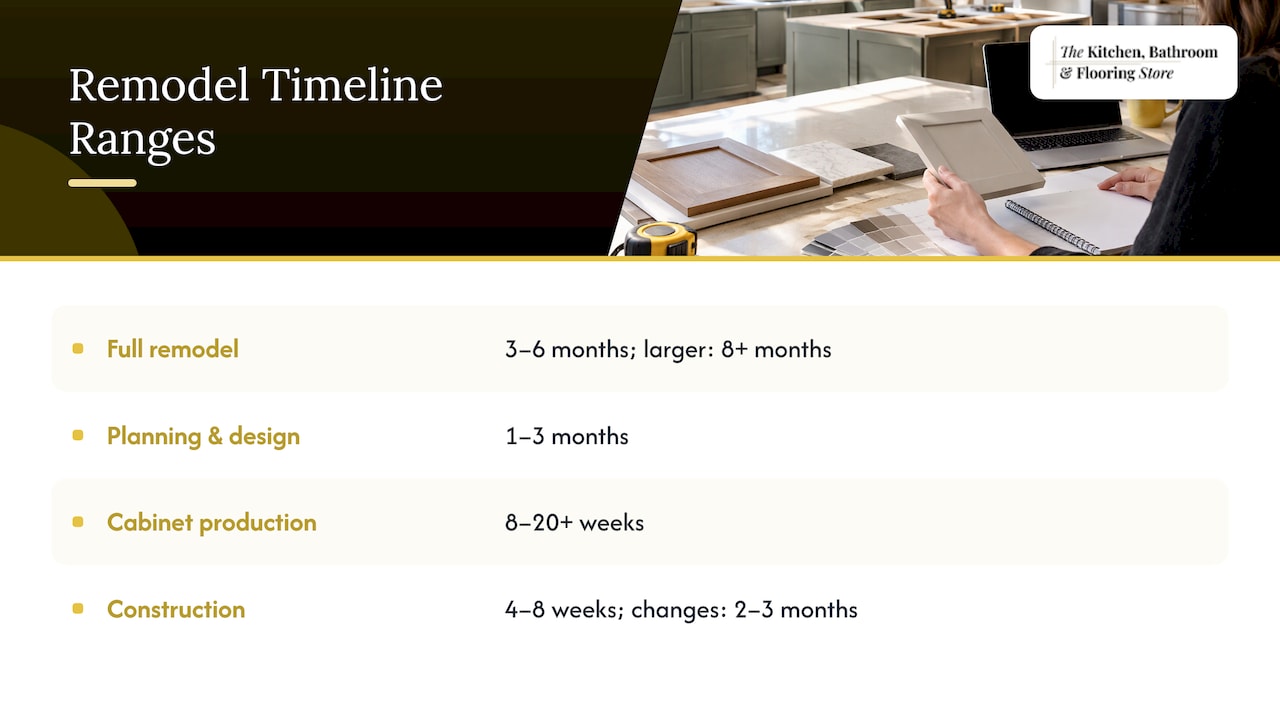
Other sources describe the building phase itself as shorter. U.S. News cites four to eight weeks for a typical remodel, and two to three months when you change the layout, replace appliances or make structural changes. Both views fit together: construction is the short part, and design plus ordering is the long part.
Cabinet type changes the timeline a great deal. As a general guide, stock cabinets are usually quickest, semi-custom take longer, and fully custom take the longest. Countertops add another step, because stone and quartz are typically fabricated only after the cabinets are in and the templates are made.
Say you want your kitchen finished before spring entertaining in April. Here is how that could work:
Our own kitchen remodel timeline goes deeper on why cabinets come first and how to build a cushion into the budget.
If your project is a gut renovation, a gut-renovation cleanout is a useful part of the demolition phase to understand, since old cabinets, appliances and debris need somewhere to go.
People often ask what time of year is cheapest. Honest answer: the savings are real but modest compared with the choices you make about scope and materials. Slower periods can bring easier scheduling and sometimes seasonal promotions on products, but we do not recommend building a project around a rumored discount.

A bigger lever is the size of the project. Homes.com, citing Angi, lists minor kitchen remodels at $10,000 to $20,000, major remodels at $20,000 to $65,000, and complete remodels at $65,000 to $130,000 or more. So $10,000 can cover a minor remodel, not a full gut. What matters more than the month is knowing which tier you are in before you book.
To keep costs under control:
Cold is rarely the issue here. Humidity, heavy rain and the Atlantic hurricane season are. A few practical points:
The right month for your neighbor is not necessarily right for you. Think through these before you commit:
If you need the kitchen back quickly, look at our fast kitchen renovation options to see what a shorter project can include.
When homeowners call us, the first question is nearly always “What month should we start?” We understand why. But in our experience the month matters less than whether the plan is settled before the work begins.
That is why we handle the project from A to Z: design help, product selection, installation and project management in one place. When one team handles the cabinets, countertops, tile and flooring, there is no gap between the person who orders materials and the person who installs them. That is the most common place for schedules to slip.
Our advice is simple. Come in during the fall or earlier, pick your cabinets first, and let us build the schedule backward from the date you want your kitchen back. Our packages are designed to fit your budget, and we offer financing with monthly payments so timing does not have to depend on having everything saved up first.
Anna
If you are in Jacksonville, St. Johns, Duval or Clay County and want a realistic start date, we can help. Our kitchen remodeling packages cover design, cabinets, countertops, flooring and installation under one roof, with financing options available.
Stop by the showroom or visit our website to set up a design consultation. Bring photos, a rough budget and the date you would like to be cooking again. We will work backward from there.
Planning a bath too? The same logic applies. Our bathroom remodel order guide explains why plumbing and ventilation come first.
Generally, the slower months after summer and around the holidays, when remodelers have more open calendar space and some suppliers run promotions. Savings vary by project, so ask for a written quote and schedule. Scope and materials will move your total far more than the month does.
Plan on about six months before you want to use the finished kitchen. Design usually takes one to three months, and custom cabinet production and delivery alone can take 8 to 20 or more weeks. Starting in fall puts you in a good position for a winter or early spring finish.
It can cover a minor remodel. Angi’s figures, as reported by Homes.com, put minor kitchen remodels at $10,000 to $20,000, with major remodels starting at $20,000. A design consultation helps you decide what a given budget can realistically include.
Most families do. Set up a temporary kitchen with a microwave, a small cooktop or a grill, and a place to wash dishes. The sink and stove are usually the hardest to do without, so ask your project manager when those will be out of service.
You do not have to, but plan around it. Schedule demolition during a calm stretch, confirm delivery plans in advance and keep a buffer in the timeline. Starting in late fall or winter avoids the issue for most projects.