
Yes, quartz can look remarkably like marble, and it asks far less of you day to day. Marble-look quartz is an engineered stone printed with soft gray or bold dramatic veining on a white or warm background. You get the classic look of Carrara or Calacatta in a surface that does not need sealing. This guide shows you how the styles differ, what to look for in a sample, and how to match a slab to your kitchen or bath.
No. Marble is a natural metamorphic stone quarried in blocks and cut into slabs. Quartz countertops are manufactured. Ground natural quartz is bound with resin and colored with pigments, then pressed into slabs. According to Bob Vila’s comparison of the two surfaces, engineered quartz typically contains 90 to 94% stone and 6 to 10% resin, and some higher-end options are made to mimic marble.
That difference explains everything you will notice in the showroom:
If you love the idea of real marble and accept that it will patina, we are happy to show you that too. If you want the look with a calmer maintenance routine, marble-look quartz is the surface to compare first.
These two names come from the Italian marble tradition, and quartz makers borrow them to describe two looks. The names are used loosely from one product line to the next, so treat them as design families, not strict definitions. When you compare slabs, trust your eyes over the label.
| Feature | Carrara-style | Calacatta-style |
|---|---|---|
| Background | Soft white to light gray | Brighter, cleaner white, sometimes warm |
| Veining | Fine, feathery, low contrast | Larger, bolder, higher contrast |
| Vein color | Gray, sometimes blue-gray | Gray, charcoal, and often gold or taupe |
| Overall feel | Calm, traditional | Dramatic, statement-making |
| Best for | Busy kitchens, classic and transitional homes | Islands, waterfall edges, focal walls and vanities |
Carrara-style quartz is forgiving. The gentle veining reads as a soft cloud of gray, so crumbs, small marks and seams are easy for the eye to skip over. It pairs well with white, shaker-style cabinets, painted gray or navy bases, and brushed nickel or black hardware. For a family kitchen where the counters work hard, it is the safe, timeless choice.
Calacatta-style quartz asks to be seen. The bold veins look best on a large surface, such as a big island or a continuous backsplash. Pair it with simpler cabinets so the stone carries the room. If you plan a waterfall edge, a dramatic pattern is where that detail shines, because the vein appears to flow down the side of the island. Our guide notes the waterfall edge can add roughly $1,000 to $2,000, so it helps to decide early whether you want the statement.
Many homeowners land between the two: a clean white background with moderate, slightly irregular veining. It gives you the movement of Calacatta without the high contrast. If you are torn, ask to see three slabs side by side, one from each group plus a middle option.
Finish changes how much the slab looks like marble in real light.
A useful test: carry the sample to the window and tilt it. If you can see your reflection clearly, that is polished. If the veins glow softly with no mirror effect, that is honed. Decide which one you can live with at 7 a.m. when the sun hits your counter.
Here is where the practical case is strongest. A surface guide from a professional fabricators’ federation describes engineered quartz as low-porosity, highly stain-resistant and highly scratch-resistant, with no need for surface sealants. The same guide rates marble as average for scratch, heat, chemical and impact resistance.
In a kitchen, that has real effects:
Florida kitchens deal with humidity, sunlight and busy households, so a low-maintenance surface matters. For bathrooms, a marble-look top on a vanity gives you the spa feel without the worry of toothpaste, cosmetics and cleaners marking natural stone. You can browse our bathroom vanities to see how a marble-look top changes a small room.
The routine is simple, and that is the point.
We built a two-minute routine around one daily habit in our guide to quartz countertop maintenance. It is worth a read before your new counters arrive.
Price depends on the slab line, thickness, edge profile, the size of your layout and the amount of cutting required. Dramatic, large-pattern designs often sit in higher price tiers than simple white options, and edge details add cost.
For planning, our own Jacksonville cost breakdown suggests budgeting around $65 per square foot. You can see what that covers in our itemized quartz cost guide. That is a planning figure, not a quote. Your final number depends on your layout and selections, and we confirm it in writing after measuring.
Things that move the total:
Because we also handle cabinets, flooring and installation, you can bundle the work and avoid paying several contractors to coordinate with each other. If you are planning financing, ask us about monthly payment options when you request your design appointment.
A marble-look slab is a visual purchase. These checks help you avoid regret.
Small samples show the color but not the pattern. Veining that looks elegant on a 4-inch square may repeat or cluster on a full slab. Ask to see the full slab, or a large photograph of it, before you commit.
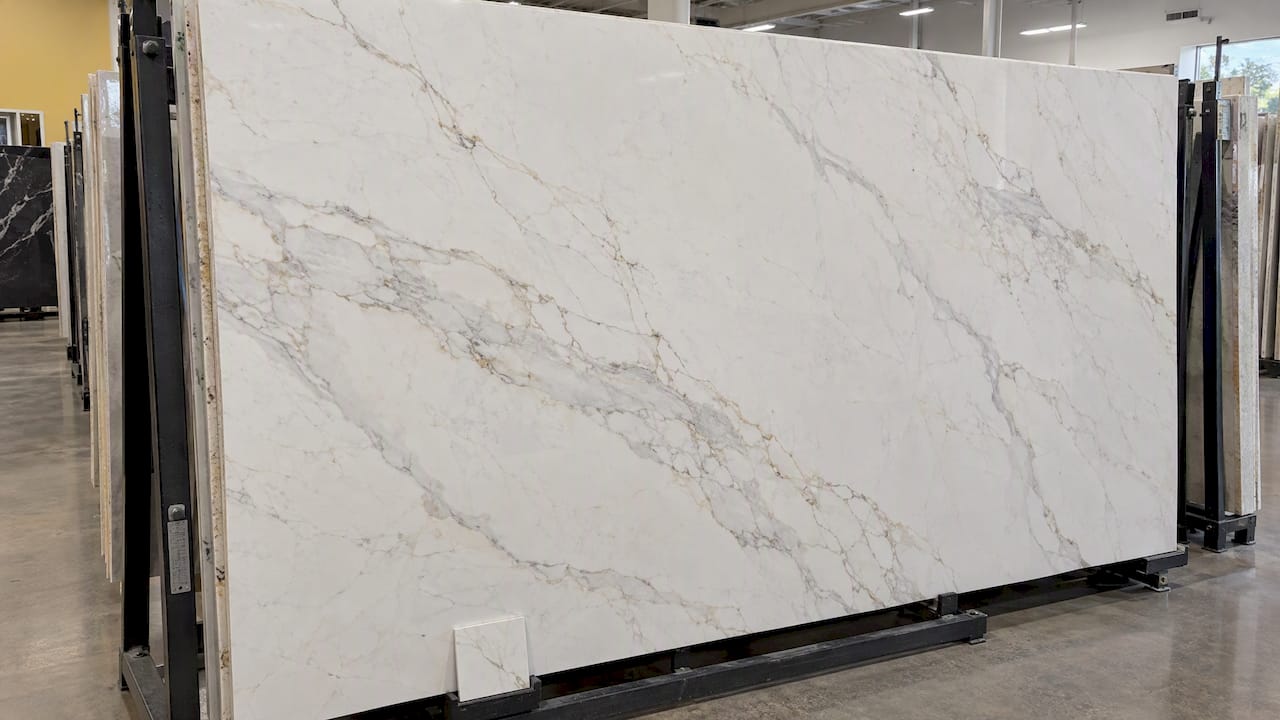
Take the sample home. Set it on your existing counter and look at it in the morning, at midday and with your evening lights on. Warm bulbs make white slabs look creamier, and cool bulbs make them look bluer. Check it next to your cabinet color, flooring and backsplash tile, since undertones need to agree.
White quartz is never just white. Some leans warm with beige or gold veins, and some leans cool with gray or blue veins. Hold a white paper next to the sample to see which direction it goes, then match your paint, tile and hardware.
Most kitchens need at least one seam, since slabs have a maximum size. Good fabrication places seams where they are least noticeable, and a pattern with gentle veining hides them more easily. Our article on quartz countertop seams shows where they go and how to minimize them.
Bold veins have a direction. Ask how the fabricator will lay out each piece, so the veining runs the same way on the island and the perimeter. On a waterfall island, ask to see the layout before cutting begins.
If your cabinets, floor and backsplash are all busy, a calmer slab keeps things balanced. If everything else is plain, a bolder slab can anchor the room. Looking at your counters and floor together saves you from picking each in isolation. Our flooring selection is under the same roof for exactly that reason.
Kitchens. This is the most common use. White or light gray counters brighten a room, and the surface handles cooking and family life.
Bathrooms. Vanity tops, tub decks and shower surrounds give you a clean, spa-like look. For wet areas, pair the top with moisture-ready tile and fixtures. Our bathroom remodeling packages bring the pieces together.
Islands and waterfalls. A large island is where the veining gets to show off.
Backsplashes. Running the same slab up the wall creates a seamless, upscale look with fewer grout lines to clean.
Most homeowners who ask us about marble come in with a photo from a magazine and a worry about whether they can live with the upkeep. We understand both. The look is lovely, and the worry is fair.
Our view is that the right answer is the one you will still be happy with in ten years. For most busy households in Duval and St. Johns counties, that means a marble-look quartz with a pattern you have seen in full-size, in your own light, next to your own cabinets. We would rather spend an extra hour at the sample table than have you second-guess the choice at installation.
Because we handle design, product selection, installation and project management in one place, the counters, cabinets and flooring are chosen as a set. You do not have to coordinate a tile person, a cabinet person and a fabricator. We stand behind the work with our in-house warranty, and we keep pricing transparent so you know the plan before work begins.
Start with the look you love. We will help you work out the layout, edge and budget that make it real.
Anna
If you are ready to see slabs in person, visit our showroom or start with our kitchen countertops page. We help you compare Carrara-style, Calacatta-style and in-between designs, match them with cabinets and flooring, and handle the installation from start to finish. Counters are often part of a bigger project, so you can also explore our kitchen remodeling packages, which are tailored to your budget, with financing options available.
Bring a photo of your kitchen, a paint chip and a cabinet door if you have one. That is all we need to start.
No. Marble is a natural quarried stone, and quartz is an engineered product made mostly of ground stone bound with resin. Typical quartz is 90 to 94% stone and 6 to 10% resin. That construction is why quartz can copy marble’s pattern while resisting stains better.
No. Quartz is low-porosity and does not require surface sealants, according to the fabricators’ surface guide. Some manufacturers specifically advise against sealing or waxing. Wipe with warm water and mild soap and avoid abrasive pads.
Carrara-style quartz has a softer white-to-gray background with fine, feathery veins. Calacatta-style quartz has a brighter background and bolder, more dramatic veining. Names vary between collections, so compare actual slabs side by side instead of relying on the label.
Not directly. Quartz has good heat resistance but is not suited to high heat, so the surface guide recommends trivets. Set hot pots and baking sheets on a pad, and the counter will look new for years.
It can be. Honed quartz has a soft, low-sheen look that feels more like natural stone and cuts glare. It may show oil and smudges more than polished, so plan on wiping it down regularly.