
An AC rating tells you how well a laminate floor’s top layer resists surface wear. The scale runs from AC1 to AC5, and a higher number means a tougher surface. For most Jacksonville homes, AC3 is enough for every room, AC4 adds a cushion for busy households, and AC5 is built for commercial traffic. This guide explains each level, what the number leaves out, and how to choose.
AC stands for Abrasion Class. It comes from the European standard EN 13329, which classifies how well laminate resists wear. The rating describes wear resistance only. It is not part of the North American laminate standard, though it appears widely in North American marketing. North America’s trade group, NALFA, uses its own certification levels instead: Residential, Light Commercial, Commercial and Heavy Commercial, each with criteria for wear, scratch, impact and stain.
The core of the rating is the Taber abrasion test. Abrasive wheels spin on the surface until they wear through the printed layer, and the number of rotations at the start of that wear-through is called the Initial Point, or IP. The test is run at several spots on the sample. A floor must also pass tests for impact resistance, stain resistance, edge swelling and burns before it can be classed at a given level.
In plain terms: the AC number is a wear score for the top layer. It is a useful number, and it works best when you read it alongside the rest of the spec sheet.
This is the scale under EN 13329, with the minimum Taber rotations for each class, as listed in the published standard.
| AC class | Minimum Taber rotations | Typical use |
|---|---|---|
| AC1 | 900 | Light domestic use, such as a rarely used room |
| AC2 | 1,500 | General domestic use |
| AC3 | 2,000 | Heavy domestic use, light commercial |
| AC4 | 4,000 | General commercial, busy homes |
| AC5 | 6,000 | Heavy commercial |
| AC6 | 10,000 | Very heavy commercial, rarely seen in homes |
Most retail laminate you will see in a showroom sits at AC3 and above. Many current lines start at AC3, so AC1 and AC2 are mostly a historical footnote when you shop.
The numbers say it clearly: AC4 needs at least 4,000 rotations to wear through, and AC3 needs at least 2,000. On paper, AC4 has twice the wear threshold.
In practice, here is how the two are commonly described:
So is AC4 laminate good for a home? Yes. It is more than a typical household requires, which makes it a sensible choice for a house with several kids, large dogs, a home business with clients walking through, or a main hallway that every family member crosses all day.
NALFA’s own guidance adds useful perspective. When you look at the AC rating alone, few laminate products ever wear all the way through to the pattern, and a consumer who chooses AC5 may expect it to last many years, but other factors and trade-offs matter too. That is why we suggest treating the rating as one input, not the whole decision.
AC5 has a higher wear threshold, at 6,000 rotations against 4,000. It is designed for heavy commercial use in places like government buildings and large retail spaces. It is also seen as the most durable choice for homes where floors take a beating.
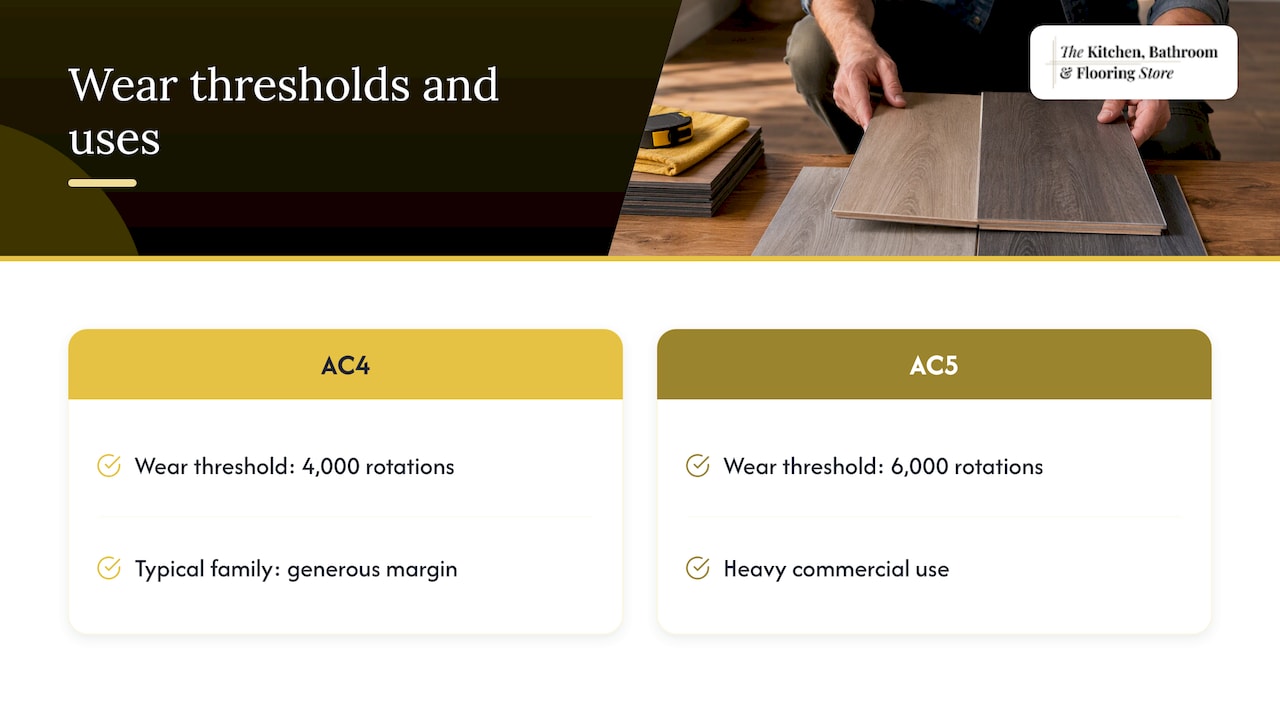
For a typical family, the gap between AC4 and AC5 is not what you will notice day to day. Scratches from furniture, grit tracked in from the driveway, and dents from dropped pans depend on more than the rating. If your home sees unusual abuse, AC5 is a reasonable upgrade. If not, AC4 already gives you a generous margin.
Two laminate floors with the same AC number can behave differently. The Taber test measures surface wear resistance only. It does not measure water resistance, dent or impact resistance, UV fade resistance, click-system strength or core density. Those are the details that matter most in Florida, so read them on the product spec sheet:
If you are comparing laminate with vinyl plank, note that vinyl uses a different measure, the wear layer thickness in mils, not an AC class. Our LVP thickness and wear layer guide explains how to read it.
Start with the traffic in each space, not with the highest number on the shelf.
A quick rule we use with homeowners: choose AC3 as your baseline, move to AC4 for your busiest zones or when you want extra margin, and consider AC5 only when your use is truly heavy.
A higher rating usually means a higher price per square foot. One 2026 cost guide puts AC3 laminate at $2.00 to $3.50 per square foot, and AC4 or AC5 at $3.50 to $5.00. Those are national material ranges, so local pricing and installation will vary.
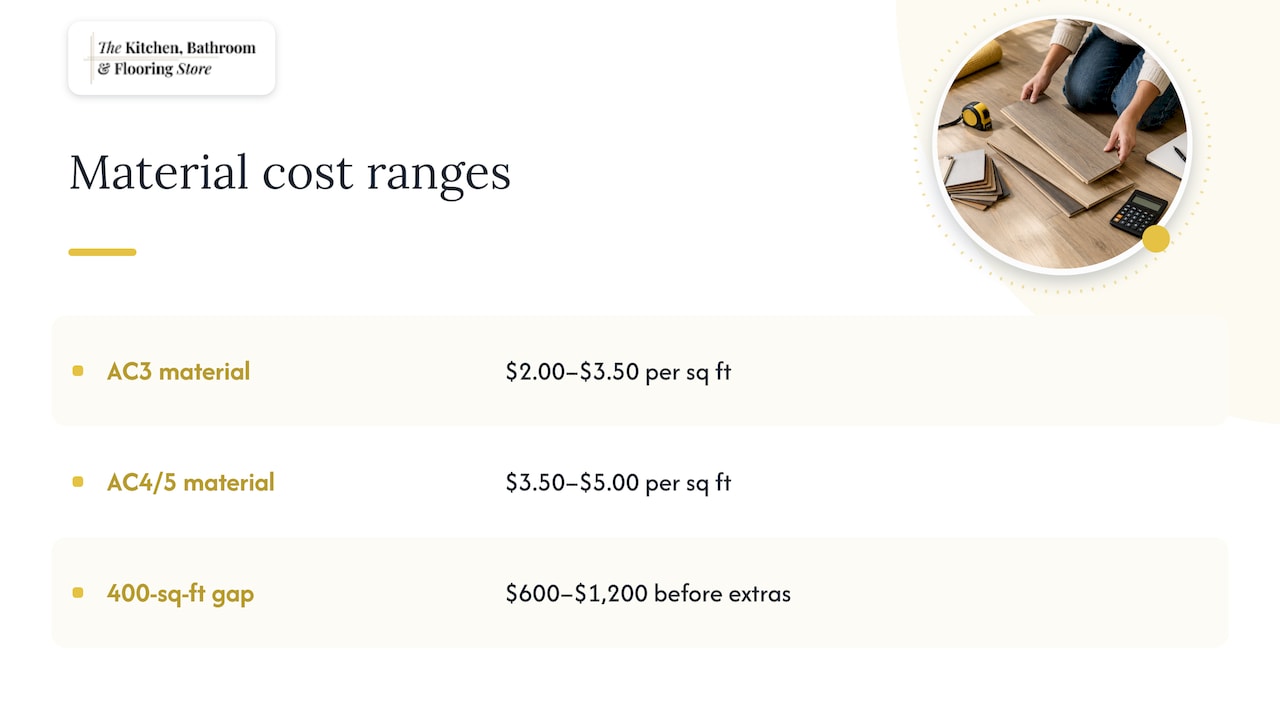
Here is a quick way to think about it. For a 400-square-foot main living area, the material difference between the low end of AC3 and the high end of AC4 or AC5 on those ranges is about $600 to $1,200, before installation, underlayment and trim. That math is only a planning tool. The best value often comes from putting the higher rating in the highest-traffic rooms and a solid AC3 elsewhere.
We talk with Jacksonville homeowners about laminate every week, and the same thing comes up: people are given a number and told to buy the highest one. We see it differently. The AC rating is a good starting point, and it works best when you pair it with how your family actually lives.
A floor lasts when the whole job is right: the rating, the moisture performance, the underlayment, a flat subfloor and careful installation. That is why we like to handle the project from design and product selection through installation and project management. When one team looks after every step, there is no gap between what was specified and what gets installed.
If you are on a budget, we can help you spend where it counts. That might mean AC4 in the hallway and kitchen and AC3 in the bedrooms, with the savings going toward better underlayment or trim. Your floors will thank you.
Anna
If you would rather not decode spec sheets alone, we can walk you through the options in person. Our showroom gives you personalized design help, a wide selection of products and professional installation, so you do not need to coordinate separate contractors. We also offer financing options on projects, and you can ask us about monthly payment plans.
Browse our laminate flooring options in Jacksonville, see our flooring and installation services, or plan a larger project with our whole-house flooring approach. If you are comparing installers, our hiring guide for residential flooring contractors lists what to look for. We serve homeowners in Duval and St. Johns counties.
Yes. AC4 is classed for general commercial use, so it has a large wear margin for a home. It suits busy households, hallways and kitchens, and homes with pets or children. Pair it with good moisture performance and proper installation.
The difference is the wear threshold. Under EN 13329, AC3 needs at least 2,000 Taber rotations and AC4 needs at least 4,000. AC3 is rated for heavy residential use, while AC4 is aimed at busier spaces and gives more margin in a home.
AC5 is the heavy commercial class, with a minimum of 6,000 Taber rotations. It is designed for places like government buildings and large retail spaces. In a home, it is the most wear-resistant option, usually chosen when traffic is unusually heavy.
No. The AC rating measures surface wear only. It does not cover water resistance, dent resistance, fade resistance or the strength of the click joint. Check the manufacturer’s moisture claims and the core and edge details separately.
Not always. The AC scale is a European classification, and the North American laminate standard uses its own levels. Many North American brands still show an AC number in their marketing, so look at both the AC class and the certification level on the spec sheet.