
The main ways to finish an exposed tile edge are a metal or PVC profile (the “Schluter-style” strip), a bullnose tile, a mitered edge, a decorative liner, or caulk on edges that already look finished. Metal profiles suit modern designs and busy areas. Bullnose suits a classic, continuous look. The right pick depends on the tile you chose, where the edge sits, and the style you want. Below, we walk through each option, show where it works best, and cover the checks that keep you from ordering the wrong piece.
Every tiled surface ends somewhere: at the outside corner of a shower wall, along the top of a half-height bathroom wainscot, at a niche, at the edge of a backsplash, or where a tile floor meets hardwood or carpet. A cut tile shows a raw, unglazed side. Left alone, that edge looks unfinished and can chip.
An edge profile does two jobs. As Schluter explains, the perforated leg of the profile locks into the thin-set under the tile, while the visible part finishes and protects the tile edge. That is why the trim is planned as part of the tile assembly, not added as an afterthought.
The decision is best made before tile goes up. The edge you choose changes how the layout is set out, which tile pieces you order, and sometimes the order of work. In our showroom, we raise it during the design consultation, right alongside tile and grout color.
This is the option most homeowners picture when they say “Schluter trim.” The manufacturer lists aluminum, stainless steel and PVC profiles in rounded, square or flat shapes, along with cove-shaped, stair-nosing and transition profiles.
What you get:
Designer Erin Gates describes Schluter as typically an inexpensive and easy way to finish tile edges, and a well-chosen finish can look intentional rather than utilitarian. Think of a brushed brass line framing a shower niche, or a matte black edge on a white subway tile wall.
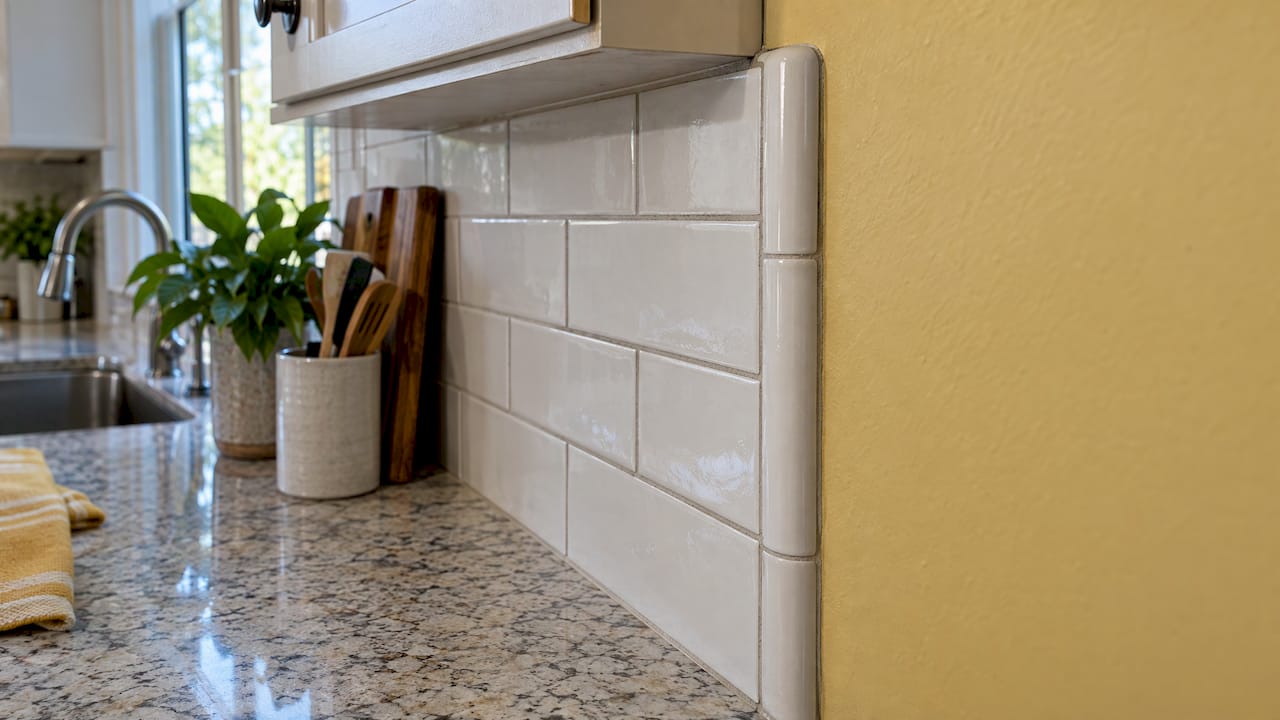
Bullnose is a tile with one rounded, glazed edge, made to match the field tile. It gives a seamless, traditional look because the finished edge is the same material and color as everything around it. Installation uses thin-set and grout like any other tile, so the edge blends into the grout lines.
The catch is availability. Some tile lines, especially large-format porcelain, natural stone slabs, and many handmade or specialty tiles, do not come with a bullnose piece. Check at the selection stage, not after the tile arrives. Bullnose is commonly used on wall caps, backsplash edges and bathroom applications, and a double bullnose (rounded on two sides) works at outside corners and counter edges.
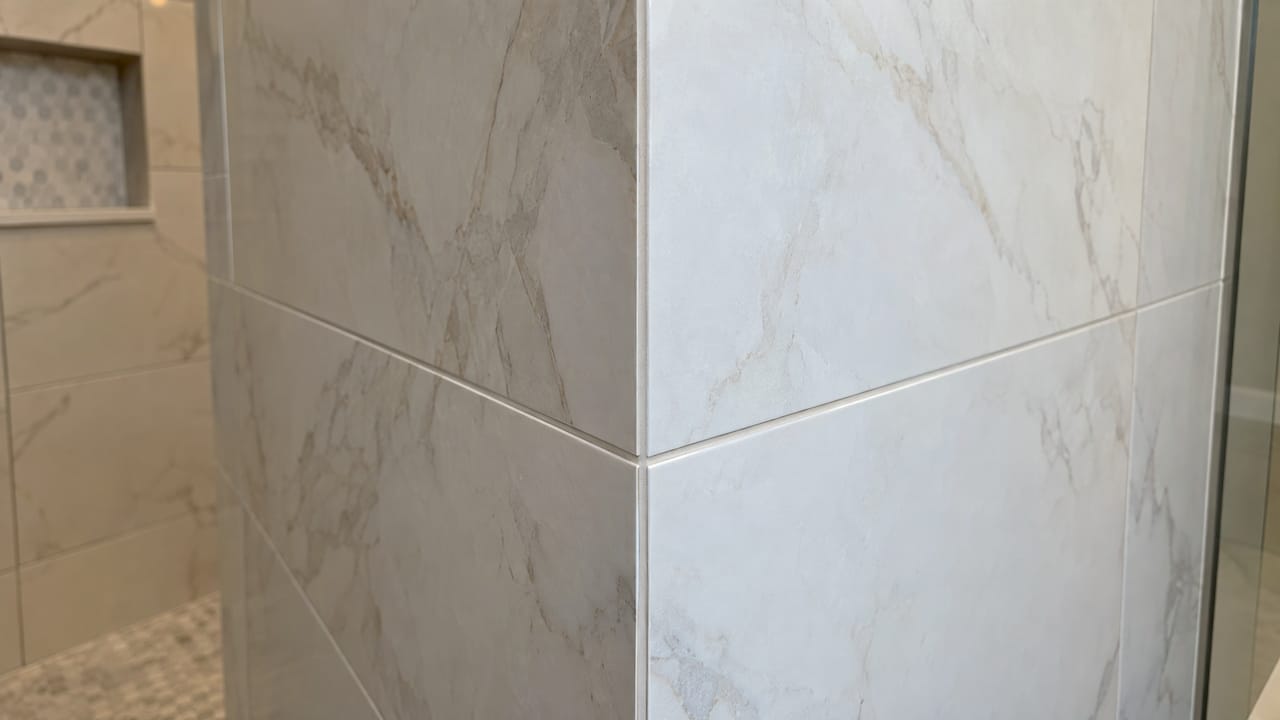
A miter cuts two tiles at roughly 45 degrees so the glazed faces meet at the corner and no separate trim shows. It is the cleanest look available, and it is popular with large-format tile and stone-look porcelain. The tradeoff is precision: the exposed miter can chip if handled carelessly, so accurate cutting and careful installation matter. We recommend leaving mitered corners to a trained installer, and using them where the corner will not take regular impact, such as a shower wall or a wall niche.
Caulk is the most economical finish, but it is for specific situations. It works where a tile edge already looks finished on its own, such as glass tile, certain mosaics, or tumbled stone, and where tile meets a different surface. At a backsplash meeting drywall, a thin line of color-matched caulk is a neat solution. It is not meant to cover a raw cut edge that people will touch or bump regularly.
Where a backsplash meets the countertop, use flexible, mildew-resistant kitchen-and-bath caulk rather than rigid grout, because the two surfaces move differently. That is a joint treatment, not an edge treatment.
These are decorative pieces. A pencil liner is a narrow, finished strip that caps a wall or backsplash. A listello is a decorative band, and rail moldings (chair rail) create a layered, traditional border. They add character and a finished top edge. Keep narrow pencil trims on walls: they can create a tripping hazard where tile floors transition to another surface.
Some edges have specific pieces made for them:
This is the question we hear most. The short answer: metal trim is the modern, protective, flexible choice; bullnose is the classic, integrated one.
| Factor | Metal or PVC profile | Bullnose tile |
|---|---|---|
| Look | Contemporary, defined line | Traditional, continuous with the tile |
| Availability | Works with nearly any tile thickness when you pick the right height | Not offered with every tile line |
| Edge protection | Covers and protects the cut edge | Glazed rounded edge, protection depends on the tile |
| Installation | Set into thin-set before the last tile row | Set with thin-set and grout like the field tile |
| Color options | Many metal finishes and colors | Matches the tile color exactly |
| Best for | High-traffic corners, floors, modern designs | Wall caps, backsplashes, classic bathrooms |
Home Depot’s guide makes a similar point: metal profiles are durable in high-traffic areas and quicker to install, while bullnose has a classic look but is not available in every tile type.
One more point worth knowing: a bullnose tile is a finished edge, not a waterproofing component. It relies on the substrate behind it for water protection. Certain metal profile systems can be integrated into a waterproofing plan, so if you are tiling a shower, ask your installer how the edge works with the waterproofing layer.
A simple rule of thumb: if you want the edge to disappear, choose bullnose or a miter. If you want the edge to be a feature, or your tile has no bullnose, choose a profile.
| Location | Good options | Notes |
|---|---|---|
| Shower wall outside corner | Metal or PVC profile, miter | Corner sees water and bumps, so durability matters |
| Top of a tiled wall or wainscot | Bullnose, surface bullnose, profile, rail molding | Pick for style: classic vs. modern |
| Shower niche | Profile, miter, bullnose | Metal can frame it as a design feature |
| Kitchen backsplash end | Profile, bullnose, caulk (finished edges only) | Match to the tile and cabinet style |
| Backsplash to countertop | Flexible caulk | A joint finish, not an edge finish |
| Tile countertop edge | V-cap, double bullnose, profile | Curved edge helps with spills |
| Floor transition | Reducer or transition profile | Choose height to match the adjoining floor |
| Floor to wall | Cove base, baseboard | Cove makes corners easier to clean |
| Stairs | Stair nosing profile | Adds safety and protects the step |
For walls and backsplashes, Schluter says its JOLLY profiles are a versatile choice, and that specialized profiles exist for floors, transitions and stairs. For heavy-duty floors, stainless steel profiles can withstand high mechanical stress.
Backsplash ends are some of the most visible edges in a home. Where the backsplash stops at a window, an open wall, or a range hood, a profile or bullnose gives a crisp finish. Where it runs into a cabinet or wall, caulk or a tight cut may do. Our guide to kitchen backsplash ideas covers layout and grout choices, and you can see samples on our kitchen backsplash tile page.
Bathrooms have the most edges: niches, shelves, curb tops, and wall terminations. Because water and cleaning products are part of daily life here, we favor durable, corrosion-appropriate materials (see the next section). If you are still choosing a look, our 2026 bathroom tile trends and bathroom tile patterns articles can help you decide how bold the edge should be.
Tile countertops are less common than stone or quartz, but if you have one, the edge needs a purpose-made piece. If you are weighing solid surfaces instead, see why countertop edge profiles matter for a look at how the edge shape changes the whole feel of a kitchen.
A few quick checks prevent most trim mistakes.
If your project involves tiling over an existing surface, the edge height changes too. Our checklist on tile over tile in a bathroom explains why added thickness affects trim choice.
Sometimes, with limits. Metal trim is ideally installed before the final row of tile, because its anchoring leg is set into thin-set under the tile. If the tile is already up, you have some options:
Caulk is not recommended for raw or frequently touched exposed edges. If your tile has a rough cut edge, plan on a proper profile or replacing the end tiles. A short conversation with your installer before the project starts is much easier than an after-the-fact fix.
For natural stone or through-body porcelain with no matching bullnose, another route is to grind and polish the edge. It is difficult and usually sent to a fabricator, so budget time for it.
Most homeowners pick tile first and think about the edge last. We would flip that. The edge is what people see and touch every day, and it is where a remodel looks either finished or rushed.
When we sit down with a customer, we ask three questions: how bold do you want this to look, how much wear will this spot take, and does your tile even come with a matching bullnose? The answers usually point to the right finish in a few minutes. A shower niche in a modern bath often wants a clean metal line. A classic subway backsplash may look best with bullnose. A floor transition needs a profile made for it.
Because we handle design, product selection and installation under one roof, the trim is chosen with the tile, ordered with the tile, and installed by the same team. That means the height matches, the finish coordinates with your fixtures, and nobody is waiting on a second contractor to show up with a missing piece.
Your tile will thank you for a good edge.
Anna
If you are remodeling in Jacksonville, St. Johns, Duval or Clay County, we can help you choose the tile, the trim and the installer in one place. Our team offers personalized design help, a showroom to compare materials, and professional installation, so you do not need to coordinate separate contractors. Start with our bathroom remodeling packages or our bathroom tile contractors page, or visit the kitchen remodeling packages for backsplash and countertop projects. We also offer financing options with monthly payments, so ask about them during your consultation.

Wondering what the tile itself will cost? Our bathroom tile cost guide explains what drives the total, and our overview of tile in modern bathrooms can help you picture the finished room.
There is no single best edge. Metal or PVC profiles are a strong all-around choice for corners, floors and any tile without a bullnose. Bullnose is a good match for classic wall caps and backsplashes. Choose by location, style and how much wear the edge will take.
Schluter-style trim is a metal or PVC profile set under the tile edge, giving a modern line and a protected corner. Bullnose is a tile with a rounded, glazed edge that matches the field tile for a seamless, traditional look. Bullnose is not available for every tile, while profiles work with nearly any tile when the height is right.
In some cases. Color-matched caulk works on finished factory edges, and rail moldings or certain metal profiles can often be added later. Metal trim is best installed before the last row of tile, so plan your edges before the tile goes up.
Match the profile height to your tile thickness so the edge sits flush. Too tall creates a trip hazard, and too short may leave the edge exposed. Measure the tile you are actually installing and confirm the size with your installer before ordering.
It is the most economical option, and it works well for edges that already look finished, like glass or certain mosaics, and for joints where tile meets a wall or countertop. For a raw cut edge that people will touch, use a profile, bullnose or miter instead.