
The most fade-resistant floors are vinyl (LVP), good laminate and porcelain or stone tile. Solid wood and carpet change color the most under strong sun. No floor is fully “UV-proof,” though. How much a floor fades depends on the material, the surface layer, the glass in your windows and how you manage the light. Florida sun is strong, so this matters in Jacksonville homes with big south- and west-facing windows, sliding doors and sunrooms.
Below, we explain what “UV resistant” means on a product label, how the main materials compare, what to look for in a warranty, and how to choose flooring for a sunroom.
Sunlight fades flooring in two ways. Ultraviolet light breaks down the dyes and pigments that give a floor its color. Visible light and heat add to the effect, and they also stress the surface. Over a few years you see it as a pale patch where the sun lands each afternoon, or a darker strip where a rug sat.
A UV-resistant floor is built to slow that process. On most manufactured floors, the design you see sits under a clear wear layer, and that top layer carries the protection. The color layer underneath is the part you want to keep safe.
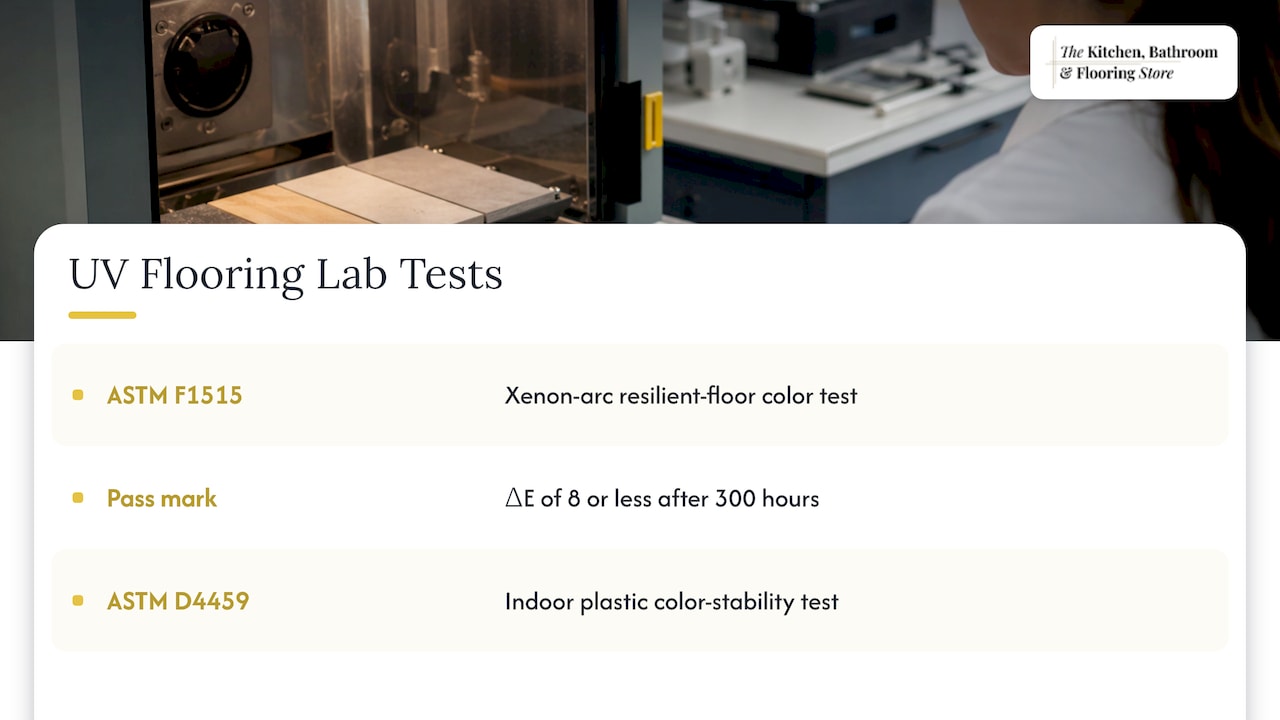
There are standard lab tests behind these claims. ASTM F1515 is a xenon-arc exposure method that checks how much a resilient floor changes color under simulated sunlight, heat and moisture. The most common pass mark in related specifications is a color change (ΔE) of 8 or less after 300 hours of exposure. A related ASTM practice, D4459, covers exposing plastics to a xenon lamp to predict long-term color stability indoors, including light filtered through window glass.
The takeaway is that a number on a spec sheet is a lab result under controlled conditions. Your living room has its own glass, orientation and hours of sun, so use the claim as a starting point and plan the room around it.
Consumer Reports tests fading by exposing part of a flooring sample to ultraviolet light for two weeks and comparing it with the covered part. Its guide says the best laminates resist sunlight discoloration better than most wood products, vinyl is especially good at fending it off, and linoleum tends to as well. It also notes that wear, scratch and dent resistance varies by product, so fade resistance is one score among several.
Here is how we think about each option for a sunny Jacksonville room.
| Material | Fade behavior in strong sun | Best fit |
|---|---|---|
| Luxury vinyl plank (LVP) | Strong. Printed layer sits under a clear wear layer | Living areas, kitchens, sunrooms |
| Laminate | Strong in better products with a protective top layer | Dry, bright rooms |
| Porcelain and stone tile | Color is part of the material, so fading is minimal | Sunrooms, entries, kitchens, baths |
| Engineered or solid hardwood | Changes with light exposure; may darken or lighten | Rooms where you can control the light |
| Carpet | Dyes can fade, and fibers vary | Bedrooms and shaded rooms |
For most homeowners who ask us about sun, LVP is the first recommendation. Its printed wood or stone look sits beneath a wear layer, and that layer is what protects the image. Thicker wear layers also give you more durability underfoot. Our LVP thickness and wear layer guide explains what the numbers mean, and you can browse the luxury vinyl plank options we carry.
Two cautions apply to every vinyl product. Heat from direct sun can make a floor surface very warm, and installation instructions on gaps and glue-down or floating methods matter more in sunny rooms. We cover both in the installation planning below.
Quality laminate has a protective surface that resists fading well, which is why it ranks so high in sun-resistant searches. It is a good match for a bright, dry room. Laminate is a wood-based core, so it is less forgiving than vinyl with moisture, which is the reason we point wet or humid spaces toward waterproof products.
Porcelain tile is fired, and its color runs through the body or sits in a glaze that is not sensitive to UV. It is the most fade-proof surface for a room that gets hours of direct sun. The trade-offs are a harder, cooler feel underfoot and grout lines to maintain. Shaw’s care guidance, discussed below, also notes that excessive heat can cause tile expansion, so installation method and expansion joints matter in rooms that heat up a lot.
Wood is a natural material, and sunlight changes it. A technical FAQ from a hardwood finish maker in Australia explains that UV and oxygen cause wood to oxidize. Some species darken, others lighten, and the document advises avoiding direct sunlight where possible. That does not make hardwood a poor choice. It means a wood floor in a sunny room needs a plan: window coverings, a finish suited to the room, and a habit of rearranging rugs and furniture now and then. Our 3-step test for light or dark floors looks at how finish and species show change in the light.

Carpet fibers and dyes vary widely. For a room with all-day sun, we steer most people toward a hard surface and use carpet in shadier bedrooms and lower-light spaces.
Yes, in the sense that matters for most homes: vinyl is among the better materials at keeping its color. Consumer Reports’ guide says as much, and the protective wear layer is the reason. Still, resistance is not the same as immunity. Large south-facing glass, a hot afternoon sun and years of exposure can still produce slight change in any printed floor.
What affects the result:
If you want a longer list of how vinyl holds up to daily life too, our guide to scratch-resistant flooring for pets and kids pairs well with this one.
A sunroom is the hardest test a floor faces at home. It gets more direct light than any other room, the temperature swings between seasons, and in Florida there is humidity and the occasional wind-driven rain through an open door. The floor needs to do three things: resist fading, tolerate heat and cold without moving, and shrug off moisture.
That is why we usually recommend one of two options.
We would be cautious with solid hardwood and standard laminate in a fully glazed room, because moisture and temperature swings are tough on wood-based products. Engineered hardwood is sometimes used in conditioned four-season sunrooms. If you are considering it, plan on shading and ask us about the finish. Whether your sunroom is conditioned all year is the biggest factor: an air-conditioned room with good glass behaves like any living room, while an unconditioned one calls for tile or vinyl.
If moisture is also a worry, our room-by-room waterproof flooring guide goes through the options.
Some manufacturers do cover fading. As one example, LAWSON Floors warrants to the original purchaser for 25 years that its flooring surface will not wear through, stain or fade from sunlight or artificial light under normal residential traffic. The condition is that it is installed, cared for and maintained according to the manufacturer’s instructions. That is a good illustration of what to look for, though terms vary by brand and product line.
When you compare warranties, check:
Care instructions deserve the same attention as the coverage. Shaw’s hard surface care guide advises avoiding direct sunlight for long periods, using drapes or blinds during peak sun hours, and notes that prolonged direct sun can cause discoloration. We back what we install with an in-house warranty, and we are happy to walk you through the terms for the product you are considering.
Even the most resistant floor does better with a little help. These steps cost little and work on every material.
Our room-by-room guide to sun exposure and flooring choice walks through which rooms in a typical house get the most light and what to do in each.
Most fading complaints we hear are not about a bad floor. They come from a good floor in the wrong room with no plan for the light. A homeowner falls for a hardwood look, puts it in front of a wall of west-facing glass and is surprised three years later.
That is why we start with the room, not the product. We ask how much sun it gets, whether it is air-conditioned, who uses it and what you want it to look like. Then we match the material. For many sunny rooms that means luxury vinyl or tile, and for a family that wants real wood, it means wood with a shading plan.
Because we handle design help, product selection and installation under one roof, there is no gap between the person who recommends the floor and the person who lays it. Installation details such as expansion gaps and subfloor prep matter a lot in sun-heavy rooms, and having one team responsible keeps them from falling through the cracks.
Anna
If you are planning a sunroom, a Florida room or a bright living area in Jacksonville, St. Johns or Duval County, we can help you pick the floor and install it. Our team offers personalized design assistance, a wide selection of carpet, hardwood, laminate, luxury vinyl and stone flooring, professional installation and project management, with financing options available through monthly payment plans.
See our flooring and installation services or browse the carpet, hardwood and luxury vinyl selection, then visit the showroom to compare samples in your own light. If you are updating more than the floor, our kitchen remodeling packages and bathroom remodeling packages let you keep the whole project with one team.
Sunny rooms rarely sit alone. Many homes have a bright kitchen and living space, a shaded hallway and a bedroom wing. You do not need one material everywhere. A common plan is a fade-resistant vinyl in the open, sunny areas, tile in the sunroom and entry, and something softer in the bedrooms. Our whole-house flooring plan shows how to combine three materials with a single project manager.
If you have children or allergies in the house, the same decisions touch other priorities. We cover those in our guides to child-friendly flooring options and flooring for allergies.
For most homes, luxury vinyl plank and porcelain tile are the best fits. Both keep their color well and handle heat and moisture better than wood-based floors. Good laminate also resists fading in dry, bright rooms. We choose by room, so bring in your window orientation and we can narrow it down.
Porcelain and stone tile are the closest, since their color is part of the material. Vinyl is next, as Consumer Reports notes it is especially good at resisting sunlight discoloration. No floor is fully fade-proof, so shading and window treatments still help.
Quality laminate resists fading well, and Consumer Reports says the best laminates hold up against sunlight better than most wood products. Results vary by product, so check the manufacturer’s warranty language and follow its care instructions.
Porcelain tile is the most resistant, followed by luxury vinyl plank made for variable temperatures. Both also handle moisture. Whether the room is air-conditioned all year will shape the final choice, so we look at that first.